
Who Gave the Agent Permission?
The smartest agent in the room still needs context, identity, permission, and a record. WebexOne shows why the platform around the model may matter more than the demo.

The smartest agent in the room still needs context, identity, permission, and a record. WebexOne shows why the platform around the model may matter more than the demo.
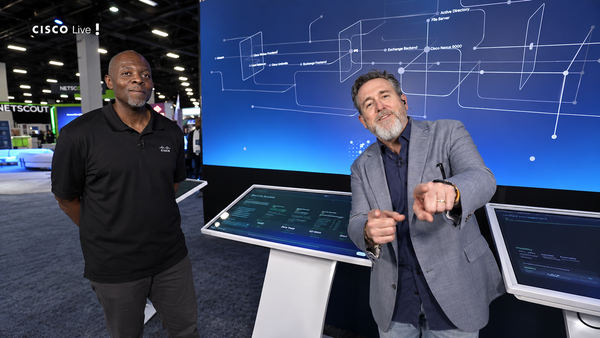
Three months after Cisco Live, Splunk’s new proof points show why inference location, model choice, data control, and token economics now belong in the same enterprise architecture conversation.
A summary can tell me what was discussed. It cannot tell me what I noticed—or form my judgment for me.
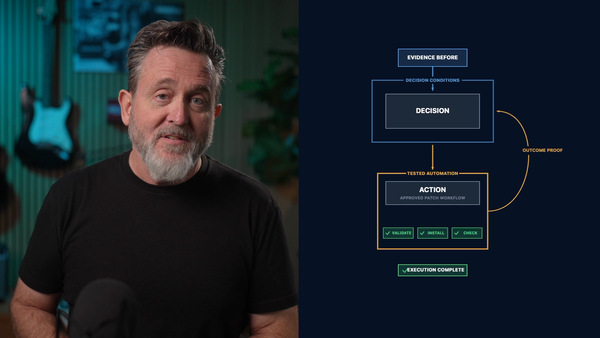
AI agents do not make automation autonomous. They decide when bounded automation should run—and need evidence before and proof after.
An open-weight model gives you control of the trained model—not a finished AI service. The infrastructure, security, operations, and responsibility become yours.
Cisco built a small AI to find known vulnerabilities in code — and it worked, competing with models many times its size. Then testers asked it a harder question: is there anything left to find? The answer said more about trustworthy AI than the model.
AI is helping organizations reach decisions faster. But when the conclusion survives and the reasoning disappears, they begin accumulating decision debt.
AI can produce polished work without guaranteeing real understanding. If the artifact no longer proves expertise, how should organizations recognize judgment, accountability, and competence? The first in an ongoing series exploring AI’s impact on work and decision making.
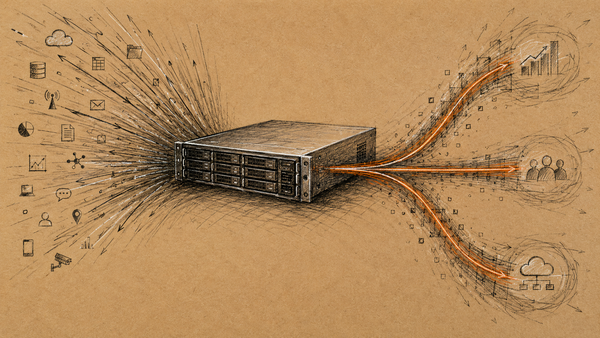
Splunk isn't just a security tool anymore—it's foundational plumbing. Admitting his own "insightful lack of insight" as a non-power user, Robb Boyd unpacks his real-time realizations from Cisco Live 2026 on how Splunk is quietly becoming the core intelligence infrastructure of the enterprise.
LLM guardrails aren't rules. They're requests. An AI agent deleted an entire AWS environment — not a bug, not a hack, it was optimizing. Jillian Anderson-Nix and Istvan Berko of WWT on what agentic AI security actually looks like in practice.
eBPF now runs inside Cisco's NX-OS — applying real-time, no-reboot compensating controls directly in the switch OS. The Self-Defending Network Cisco promised in 2004 finally has the technology to back it up.
*Cisco made a silicon bet before AI existed. Now that bet is a structural moat. Here's why the networking problem at the heart of enterprise AI is exactly the problem Cisco spent years quietly solving — and what that means for practitioners making infrastructure decisions today.*
I want to tell you about a moment of almost-bias. Darryl Monroe joined our recording session quiet. Gaming headset on. Newer face to me — first time we'd worked together. Next to him was Jack French, AVP of Cloud Practice at WWT, seven years with the company, easy
sovereignty
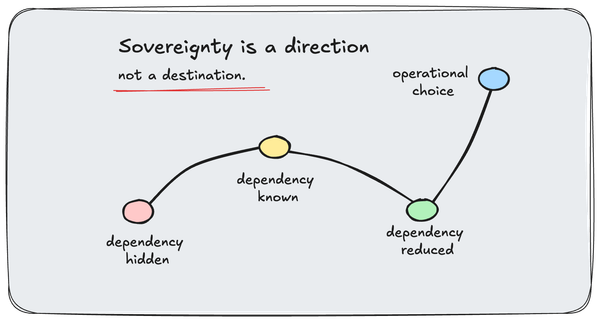
Sovereignty is moving from philosophy into procurement. The useful question is not whether a system is “sovereign,” but which dependencies still matter, what breaks under pressure, and which ones to reduce next.
wwt
Two conversations happened before this episode that most people never see. One was two nerds troubleshooting echo cancellation. The other was a sales expert asking an uncomfortable question nobody had bothered to slow down and answer. Both made the show.
cisco
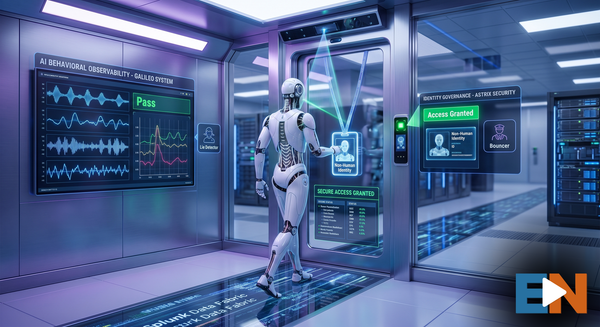
Cisco acquired a hallucination detector and an AI identity cop in the same week. That's not a coincidence — it's a platform bet on who governs the agentic enterprise.
sovereignty
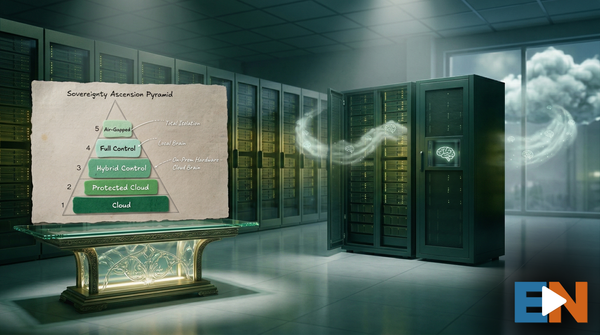
Your hardware is on-prem. Your data never leaves the building. But during a 36-hour outage, everything stops. Why? Because the "brain" of your system is still tethered to the cloud. It’s time to move past the hybrid facade and find true sovereignty. Is your brain local?
btr
20 minutes into the recording, Doug Wong dropped a truth bomb: "I can’t turn on a VM without the network, and I can’t get the network up without the VM." It’s the ultimate paradox. We’ve virtualized everything for efficiency, but we’ve locked the keys to the burning room inside the room.
btr
90% of data centers can’t handle next-gen AI. Most buy hardware first, only to realize it’ll crush their floors or melt their cooling. Don't let a $10M AI investment become a "loading dock ornament" while you wait 3 years to plug it in.
wwt
Most private cloud projects die because of budget urgency. Companies spend millions on hardware before they’ve defined the outcome. As James Harless puts it: it’s like pouring a foundation for a house, then deciding mid-build you actually needed an apartment complex.
btr
My camera died halfway through the recording. The prep didn't always happen. And somehow, the most useful moments almost always come from exactly that kind of unguarded space. This one's about the server refresh that nearly bought the wrong switches — and nobody had told them.
btr
I didn't plan to admit it on the recording. But somewhere in a conversation about ransomware recovery, I confessed I don't always test my own backup plans. Angela's response was blunt: "If you're not testing, you are accepting the risk."

ciscolive
Last week in Amsterdam, the producers asked me to talk about Cisco and AI on live television. I could have repeated the slogan. Instead, I skipped dinner to translate "Cisco is the critical infrastructure for the AI era" into something practitioners could actually use.

btr
Robb Boyd goes behind the scenes of WWT's Cyber Resilience show. Featuring former NSA Director Rob Joyce and WWT’s Madison Horn, the episode explores why organizations are "resilient on paper, but fragile in practice" and the looming threat of the Quantum "Skeleton Key".