What the Summary Can't Tell Me
A summary can tell me what was discussed. It cannot tell me what I noticed—or form my judgment for me.

I've been thinking about a conversation between Andy Lapteff and Drew Conry-Murray on The Art of Network Engineering. I've met both of them over the years, but listening to this episode made me realize how much I didn't know about either of them. One of the things I appreciated most wasn't really the stories themselves. It was the conversation.
I had no idea Drew came from a non-technical background.
I don't know why that surprised me. Maybe because he's been one of the voices of Packet Pushers for so long that I unconsciously filled in the blanks. You hear someone comfortably interviewing network engineers year after year and assume they came up through the same path.
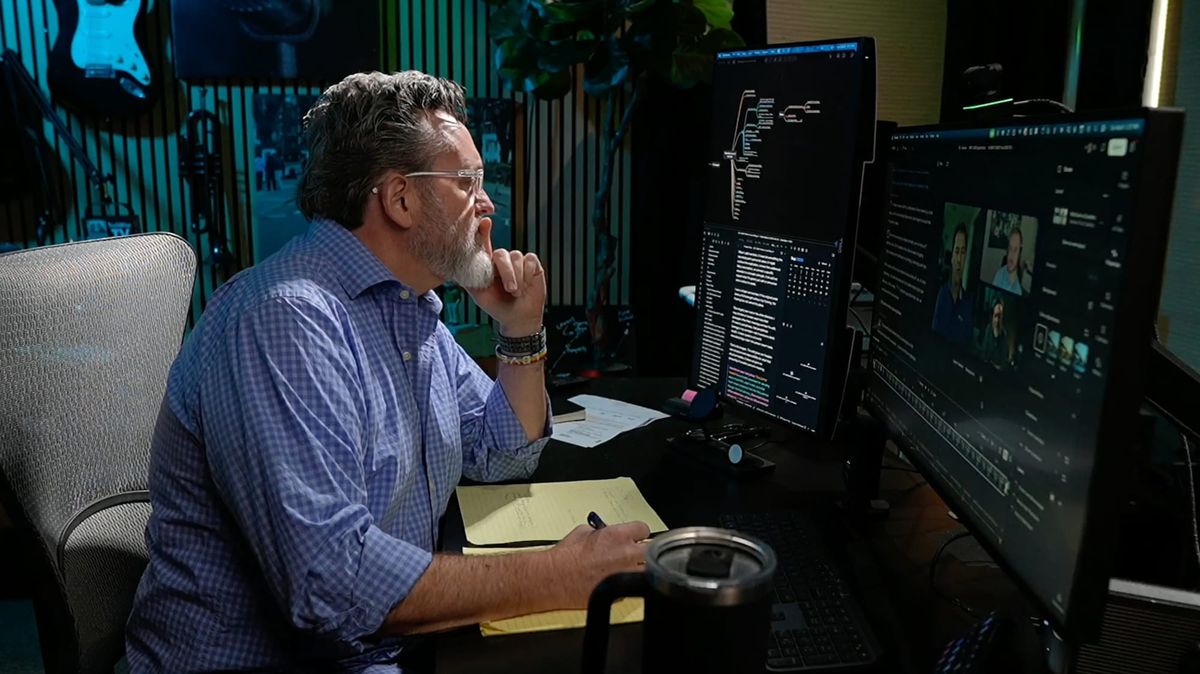
One exchange between the two of them especially caught my attention. Drew described those early years after getting thrown into the deep end as an editor for a networking publication. He didn't understand much of what he was hearing yet, so he'd record interviews and then go back and transcribe them by hand.
That made me smile because I continue doing almost exactly the same thing years later.
Nobody suggested it. I don't remember talking to anyone else who worked that way. I'd transcribe interviews, meetings, conference presentations, sometimes even videos that I wanted to understand more deeply. I still do it occasionally, although I'm much more selective now because it takes an enormous amount of time.
Looking back, I don't think the transcript itself was ever the point. It was simply the excuse to spend another hour with the conversation. Somewhere in that process I'd notice connections that had sailed right past me the first time.
I found that moving through a conversation one sentence at a time changed what I noticed. I'd catch where someone hesitated. I'd notice the analogy they reached for instead of the more obvious one. Sometimes a throwaway comment near the end suddenly explained something they'd said twenty minutes earlier.
I don't think I became smarter halfway through those transcripts. I think I simply gave myself enough time to notice things that had gone by too quickly the first time.
My ADHD has always been both a gift and a curse. Over the years, I've accumulated little habits that compensate for the parts of my brain that naturally want to skip ahead. At the time, I never thought of those habits as craft. They were just things that helped me think more clearly.
Listening to Drew describe a similar process made me wonder how many of us quietly build these little habits without ever talking about them.
The Work Hiding Inside the Work
If Drew were starting today, he probably wouldn't hand-transcribe interviews. I probably wouldn't either. I'd record the conversation, drop it into a transcription service, and within a minute I'd have a searchable transcript, a summary, action items, and probably suggested follow-up questions.
I use those tools all the time now. I wouldn't want to give them up.
What I'm less sure about is whether we should be in such a hurry to eliminate every bit of friction from the learning process.
Years ago, when I was editing guest interviews, the production team would often ask me for what we called a paper cut. They weren't networking people, so a raw transcript didn't tell them what mattered. I'd go through it with a highlighter and mark the passages I thought should survive into the final edit.
I don't think I appreciated it at the time, but every one of those "paper cuts" was changing how I listened. Every time I picked up the highlighter I was making a decision about what mattered. Which idea actually changed my understanding? Which explanation made the topic click? Which sentence sounded ordinary at first but kept nagging at me an hour later? After a while I realized those little editorial decisions had quietly become part of how I thought.
Today it's easy to skip that part. The transcript gets summarized. The summary gets condensed again. Before long, I'm looking at a beautifully written page that accurately tells me what was discussed.
What it doesn't tell me is what I noticed.
That's the part I don't want to lose.
I'm not arguing that everyone should return to manually transcribing interviews. Most people shouldn't. I probably won't do it often either.
What I don't want to lose is the small amount of effort that forces me to form my own opinion before I borrow someone else's.
Redrawing the Map While Using It
I've heard Andy ask some version of that question before, and I suspect it's one of the reasons the podcast works. On the surface it's a career question, but it often opens the door to something much more personal.
Later in the conversation, Andy asked Drew what advice he'd give someone trying to get into networking. I've asked some version of that question throughout my career because so much of my audience has traditionally been people entering technology or changing careers.
It's still a great question.
I'm just wondering whether it belongs only to newcomers anymore.
I may be projecting, but underneath all the excitement around AI and everything else happening in our industry, I suspect a lot of experienced people are wrestling with the same uncertainty. They just phrase it differently.
How do I stay relevant? How do I know what to learn next? How do I differentiate myself when the ground keeps shifting underneath me?
I've talked with architects, executives, analysts, and people who've spent decades building careers around technology. I don't think many of them would say they're standing on solid ground right now.
Customers are making important decisions before there's enough history to know whether those decisions will hold up. Vendors are building products around technology that changes almost monthly. Analysts are trying to separate signal from noise while the signal itself keeps changing.
It's exciting. It's also one of the few times I can remember when so many of us have had to redraw our mental maps while we're still using them.
It makes me wonder whether that's exactly when our own judgment matters most. Ironically, it's also when a clean, confident summary becomes most tempting. When we're uncertain, it's awfully nice to have something that sounds certain. I understand the appeal because I feel it too.
That's when my warning flags start going up. Confidence and clarity aren't always the same thing, and right now clarity is in short supply.
None of that makes me pessimistic. If anything, I'm more excited than I've been in years. There are genuinely new ideas worth exploring. Some of the assumptions I've relied on for years are also being challenged. That's both invigorating and uncomfortable.
Maybe that's why I keep circling back to craft.
When I think about the people who've influenced me, I don't remember them because they always had the answer. I remember how they approached difficult problems. They'd ask one question that made the conversation easier to follow, or draw a quick diagram that gave me somewhere to begin. The complexity never disappeared, but somehow the territory felt smaller.
I'm beginning to think that's one of the most valuable things experienced people do. They help the rest of us build better mental maps.
Maybe that's also why I've always enjoyed interviewing people so much.
I used to think I was collecting expertise.
Looking back, I suspect that's what I admired most in Drew's story. Not that he transcribed interviews. Plenty of people have done that. It was that he'd found a way of slowing himself down long enough to build his own judgment before someone else handed him theirs.
Robb Boyd spent nearly two decades at Cisco as Managing Editor of TechWiseTV, helping technical experts turn deep knowledge into stories people could follow. Today he develops and hosts expert-led technology programs. Through ExplaiNerds, he explores how we make sense of complicated technology—and the craft, judgment, and habits that help us do it.
Want more practical thinking on technology, communication, and the craft of making sense of both? Subscribe to ExplaiNerds.