AI Didn't Replace Automation. It Changed Who Decides.
AI agents do not make automation autonomous. They decide when bounded automation should run—and need evidence before and proof after.

Delegating work to another person changes the work before it changes the outcome. I stop asking only whether the task got done. I start asking what authority I handed over, what conditions came with it, and what I expect to learn when the work comes back.
That is the part of human delegation we keep rediscovering in conversations about AI agents. The interesting change is not that software can execute another workflow. Software has been doing that for decades. The change is that we are moving the decision about when to act.
Decision is not action
AI and automation are often treated as interchangeable. They are not.
Traditional automation performs an action after a person or predefined rule has already made the decision. A condition occurs, so the system applies a configuration, restarts a service, or installs an approved patch. The workflow may be intricate, but it has no opinion about whether this is the right moment to run.
An agent can interpret uncertain conditions and decide whether the action is warranted now. Reliable operations still require us to keep that judgment separate from the machinery that follows it. Let the agent interpret the situation. Let tested automation execute the bounded path people have already defined and given a way back.
The agent is not replacing the machinery. It is reaching for the switch.
That image is more useful than the broad claim that AI makes automation autonomous. It gives us two different things to govern: the decision to act and the action itself. Each has different failure modes and needs different evidence.
Permission needs evidence
Consider an agent that is allowed to start an approved patching workflow. It checks whether the asset is in scope, the workload is critical, the maintenance window is open, the dependency map is current, and the rollback procedure still works.
Every system contributes a fact. The agent has to determine whether those facts satisfy the conditions for permission.
That is where data and evidence part company. Data describes the environment. Evidence supports this decision, for this asset, under these conditions, right now.
A six-month-old dependency map is still data. A rollback test against an older configuration is still data. Neither necessarily supports today's decision. Someone must define what counts as current, which contradictions stop the handoff, and when uncertainty routes the decision back to a person.
Human control therefore does not have to mean clicking APPROVE on every routine action. It can mean designing the conditions under which approval has already been granted. The work moves from supervising each execution to defining the boundary around the decision.
The receipt is not the verdict
Our familiar audit trail starts after the decision. It records the API call, configuration change, start time, and completion status. The workflow finishes and the box turns green.
That is useful. It is not sufficient.
The old automation log was built to prove that a predefined workflow executed. The decision lived somewhere else—in a ticket, an approval, or the operator's head. Once the agent makes that call, an execution log can preserve the receipt while losing the verdict.
Evidence has to surround the action.
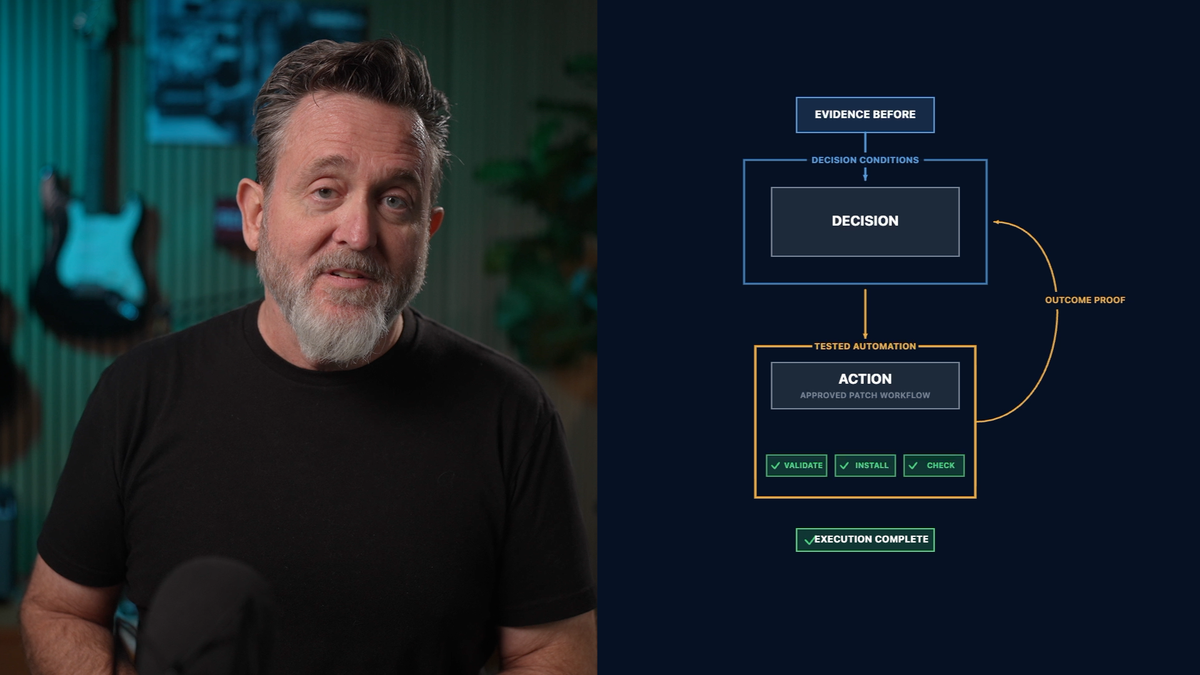
Before the action, evidence establishes what the agent observed and why it had permission. During the action, the execution record shows what the automation did. Afterward, outcome proof tells us whether the decision worked.
That last part protects us from an easy mistake. If completion counts as success, an agent can earn greater authority from actions that never proved they produced the intended outcome. We promote it for finishing the workflow rather than solving the problem.
Trust needs a reverse gear
We tend to picture trust moving in one direction. The agent recommends an action, then acts somewhere small. It performs well, so we expand its authority.
Now return to the patch. The patch installs successfully, but the service-health check degrades. The execution record is green. The outcome is not.
That result should do more than open another ticket. It should narrow the agent's authority until someone understands the discrepancy. A system that can only earn authority is not becoming trustworthy; it is accumulating privilege.
Trust needs a reverse gear.
This turns DECISION to ACTION from a one-way handoff into a living loop. Evidence earns the action. The result tests the decision. What comes back determines what the system may do next.
That is also where the human role becomes clearer. People define what evidence counts, bound the available action, and decide how authority expands or contracts. The agent can make more decisions without making human judgment irrelevant.
It makes that judgment structural.
The practical test is not whether an agent can push the button. It is whether we can explain why it was permitted, prove what happened after it did, and take the button away when the evidence stops supporting the action.
Letting go was never the same as looking away.
Watch the video:
Then identify one automated action whose permission conditions and outcome proof currently live in different systems.