Who Gave the Agent Permission?
The smartest agent in the room still needs context, identity, permission, and a record. WebexOne shows why the platform around the model may matter more than the demo.


What the WebexOne announcements reveal—and don't—about the enterprise value surrounding AI agents
At WebexOne this week, Cisco described a simple scene. Someone in a team space @mentions an analytics agent to pull usage numbers. Then they ask a presentation agent to update a PowerPoint deck with those numbers. Two agents, one workflow, no copy and paste.
It's a useful example. The keynote did not ignore trust: Cisco showed agents approved by IT and work returning to a person when approval or judgment was required.
That makes the question more precise, not less important: what exactly did IT approve? Which context, tools, actions, and delegation rights came with that approval?
Model capability is only part of that decision. The enterprise also has to control the context an agent receives and the actions it can take.
The value around the model
Cisco announced several different relationships with outside AI providers. Claude Managed Agents are coming to Webex “soon,” while an MCP integration can bring Webex context into OpenAI's dots. Google Gemini has a separate planned role in Webex customer experience. These are not interchangeable integrations today, and the models themselves are not interchangeable either.
But the variety points toward a useful hypothesis. If enterprises can use several models through the same work platform, some of the durable value may move to what surrounds the model:
- Context: What does the agent know about the work?
- Identity: Who—or what—is it acting as?
- Permission: What is it allowed to see and change?
- Record: What did it do, and can anyone reconstruct it?
The model may be the most visible participant. The platform decides what room it enters.
Webex makes the pattern visible
Webex is a useful case study because its history keeps changing what the platform can know and control.
In 2007, Cisco agreed to buy WebEx for approximately $3.2 billion. The deal included the MediaTone Network, which Cisco described at the time as a global network and platform for delivering on-demand applications. In later years, Cisco built out the Webex backbone as a private, media-optimized network connecting its data centers. Its stated design was to move meeting traffic off the public internet as early as possible and manage the route across that backbone. That is Cisco's architectural account and performance claim—not an independent verdict.
Then the platform learned to see more of the route. Cisco acquired ThousandEyes in 2020, adding visibility into internet and cloud performance. In 2022, Webex announced a Control Hub integration that could show administrators the network path behind calls and meetings. Today the ThousandEyes agent is built into RoomOS and can be enabled on supported Cisco collaboration devices.
Now Cisco is linking network, device, service-quality, and workplace data through Control Hub and tools such as AI Canvas. It is also positioning identity, security, governance, and visibility as the trust layer around agents. RoomOS 27, due in November, is supposed to add fully featured native Google Meet support alongside Webex, Microsoft Teams, and Zoom. A company could standardize on another meeting service while keeping Cisco's devices, telemetry, and management layer in the room.
Step back and a possible progression appears:
Carry the call. See the call. See the room. Govern what can act there.
The pieces of that last step are visible. Their reach across a complete workflow still needs to be tested. That is the strategic direction I see in the announcements.
The history argues against an easy story
Patterns always look more intentional in hindsight.
Before Cisco converged Spark and Webex in 2018, Spark meetings ran on public-cloud servers and did not use the Webex backbone. Cisco then brought those meetings onto the backbone while also connecting the backbone to servers in public clouds. The supposed moat changed shape because the product and the market changed.
The same caution applies now. Cisco explicitly treated trust as part of the agent story in its keynote. It described tool access as necessary for an agent to become useful, warned that agents can take irreversible actions, and argued for runtime guardrails plus security and behavioral observability. The Webex demonstration showed IT-approved agents and human review points. Cisco understands the trust problem.
Useful agents require access. Access requires trust. Cisco's Jeetu Patel explains why tool access is essential to agent value. The next question is how enterprises define and enforce that access.
Cisco has published some of the mechanics. Webex documents a registry for verified agentic services, with administrator controls over enabled tools and who can use them. Its Help Center also describes centralized access controls, audit logging, and policy enforcement. Those are meaningful foundations.
The next test is what happens when an approved workflow hands work to another agent. Which identity and policy apply? Where are the limits on the particular action and its parameters enforced? Does the record connect the request, approval, tool call, and result? An approved agent is not the same as an approved action.
Cisco's security organization has gone further in describing identity-aware, time-bound credentials and policies that restrict which actions an agent can perform. But that material also says many of the features are still in development. A specific design is not the same as consistent deployment across Webex, third-party agents, and customer environments.
Delivery stages matter too. The Webex customer-experience announcement lists Splunk agent observability and agent-to-agent protocol support as planned for general availability in December 2026. Those are scoped CX roadmap items, not proof that every Webex agent already operates under one finished governance layer.
Cisco is designing capability and oversight together. The open question is whether those controls arrive with the same scope, timing, and enforcement across the platform.
Test the platform, not the demo
The four control points suggest a practical test for any agent platform:
- Context: Which systems and conversations supply the agent's working knowledge?
- Identity: How is the human, agent, service account, and delegated role distinguished?
- Permission: Who grants access and action rights—and where does that authority stop?
- Record: Can an administrator connect the requesting identity, relevant inputs, applicable policy or approval, tool action, and result?
Two more questions expose whether those controls work outside the demo:
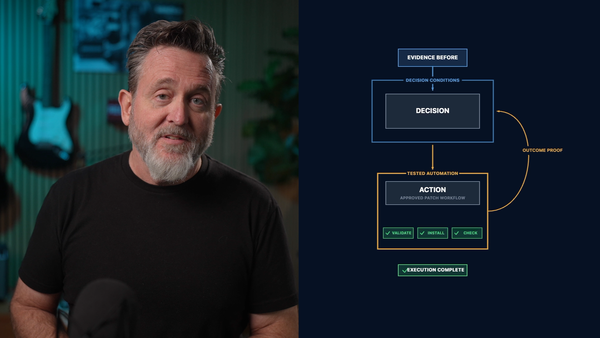
- Recovery: Can a pending action be stopped or handed back to a person? If it has already happened, can it be reversed—or at least contained and remediated?
- Outcome: What measurable result will justify granting that authority again?
No platform can answer the risk question for you. Updating a draft is not the same as changing a customer record. Scheduling an internal meeting is not the same as contacting a client. The enterprise still has to decide which actions need approval, which can be reviewed afterward, and which should not be delegated at all.
It also has to confront the boundary of the platform. Controls inside Webex do not, by themselves, govern an employee copying sensitive material into a personal AI account.
The advantage may sit one layer out
I am not suggesting that the model no longer matters, or that Cisco has already built the complete control plane for agentic work. Neither claim is supported.
I am suggesting that model comparisons can distract us from the system around the model. Enterprise agents need context, identity, permission, records, recovery, and a reason to act in the first place. A vendor that can connect those pieces without pretending the boundary is complete may matter more than the vendor with the flashiest agent demo.
Buying access to an agent is getting easier. Deciding who gave it permission remains your job.
Disclosure: Cisco is an ExplaiNerds client. This article is independent analysis; it was not commissioned or reviewed by Cisco.
Sources
- WebexOne 2026 opening keynote, October 7, 2026 (event recording and transcript)
- Cisco Unveils New Agentic Collaboration Experiences — Cisco Newsroom, October 7, 2026
- Webex AI-Native Collaboration: Context. Agents. Trust. — Webex Blog, October 7, 2026
- WebexOne 2026: From Disconnected Customer Interactions to One Continuous Relationship — Webex Blog
- Webex Leverages AGNTCY Directory and Identity for Agentic Apps — Webex Developers Blog, February 27, 2026
- What's New for Agentic Apps — Webex Help, September 4, 2026
- Zero Trust for AI Agents — Cisco Security Blog, March 23, 2026
- Cisco Announces Agreement to Acquire WebEx — Cisco Newsroom, March 15, 2007
- The Webex Backbone: Because Every Millisecond Counts — Cisco Blogs
- Cisco Completes Acquisition of ThousandEyes — Cisco Newsroom, August 7, 2020
- Count on Control Hub — Webex Blog, June 14, 2022
- Control Hub — Webex
- ThousandEyes Agent Integration for Board, Desk, and Room Series Devices — Webex Help
- Cisco Spark and Webex Platform Convergence: More Than a Rebrand — Cisco Blogs, April 18, 2018
Robb Boyd spent nearly two decades at Cisco as Managing Editor of TechWiseTV, producing technical stories for a global audience. Today he spends as much time thinking about how AI is changing the way organizations trust their own people as he does producing video for them—this piece is part of that thinking, done in public.
Want more analysis like this? Subscribe to ExplaiNerds. And if you're a marketing or content leader with a story that deserves a bigger audience—let's talk.