The Self-Defending Network Wasn't Wrong. It Was Early.
eBPF now runs inside Cisco's NX-OS — applying real-time, no-reboot compensating controls directly in the switch OS. The Self-Defending Network Cisco promised in 2004 finally has the technology to back it up.

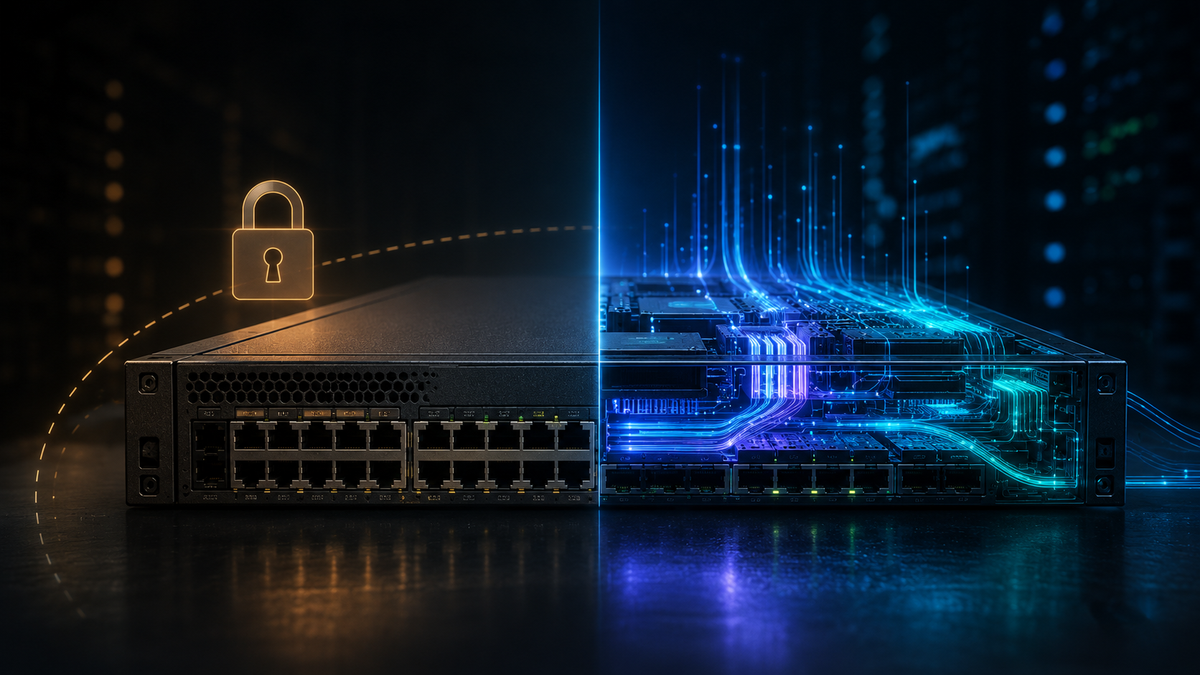
In February 2004, Cisco launched one of the most ambitious marketing campaigns in networking history. They called it "The Self-Defending Network." John Chambers carried the vision personally. The idea: infrastructure that could identify threats and respond automatically, without waiting for human intervention. Not hardened. Not monitored. Active. A network that defended itself.
I always appreciated it as marketing — even when the technical proof points hadn't fully arrived yet. That's not a knock. Sometimes the right framing exists before the right technology does. The vision got filed away under good concept, wrong moment when Cisco's own CSO quietly retired the phrase in 2011 — "a victim of its own bloated expectations," he said.
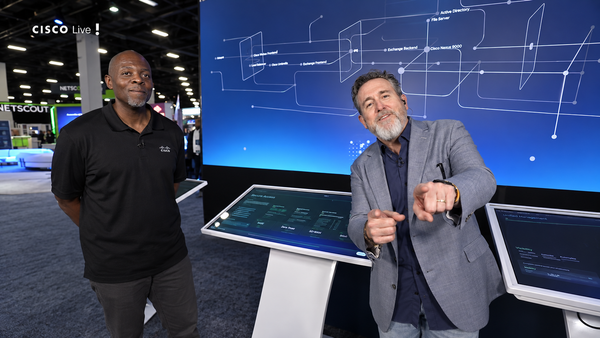
I was inside Cisco when that campaign launched. I had spent the previous year whiteboarding the exact technology that should have made it real. And last week at Cisco Live in Las Vegas, sitting in a briefing about something called Live Protect, I realized I was watching that promise finally come true — twenty-three years later, in a way I don't think anyone in 2004 could have drawn on a whiteboard.
A Whiteboard in 2003
A sales VP named Jim Sherriff — someone I was aware of, though there were several levels of management between us — told me around 2002 that security was where he wanted me to go. I'd been a commercial sales rep covering the Fort Worth area. Broad portfolio, lots of ground, head down trying to hit numbers. Cisco was doing layoffs. I was at risk enough that being on anyone's radar felt like a gift. I didn't fully understand why he saw something in me. I wasn't going to ask questions. I was grateful and a little terrified, which turned out to be exactly the right combination.
The engineers I was now supposed to be supporting had no patience for someone faking their way through IOS-based security conversations. I could feel that immediately. So I made a decision that probably saved my career: I stopped trying to compete on the stuff everyone already knew, and went looking for the things the field wasn't paying much attention to yet — the acquisitions.
Cisco was buying interesting small companies in those years, and the technology coming through the door was often ahead of where the market was ready to go. One acquisition in particular changed how I thought about security entirely.
The company was called Okena. Cisco acquired them in early 2003 for $154 million. Their product was called StormWatch.
The idea was simple to explain and hard to argue with. Rather than waiting for a known attack signature to show up in traffic — the standard approach at the time — StormWatch sat next to the kernel on an endpoint and intercepted system calls in real time. Every request an application made to the operating system: file access, network connection, registry write, process execution. Approved or rejected based on policy, before the action completed.
No signature required. You didn't need to have seen the attack before. You just needed to know what normal behavior looked like — and enforce it at the moment it happened.
There was a running joke on sales calls early on — the engineers didn't let just anyone have the whiteboard marker. It was a rite of passage, light-hearted hazing, the kind of thing that doesn't feel like hazing until you earn your way out of it. Once I figured out how to give this pitch with a marker instead of slides, something shifted. My hit rate went up. I felt like I actually understood the architecture. The people in the room retained it better too, or at least that's how it felt.
If you intercept the system call before it executes, it doesn't matter how novel the attack is. You're not chasing threats after the fact. You're defining acceptable behavior and blocking everything else.
The problem was the agent.
To deploy StormWatch — later rebranded as Cisco Security Agent, CSA — you had to put software on every endpoint. Every desktop. Every server. In a large enterprise, that's a massive operational lift, a change management project, an ongoing maintenance burden. Adding anything to an endpoint in that era was a hard sell, no matter how elegant the underlying idea was. This was, in hindsight, exactly the technology Cisco would need to actually deliver on a promise they hadn't made yet.
So the technology found its fans. It never quite found its moment.
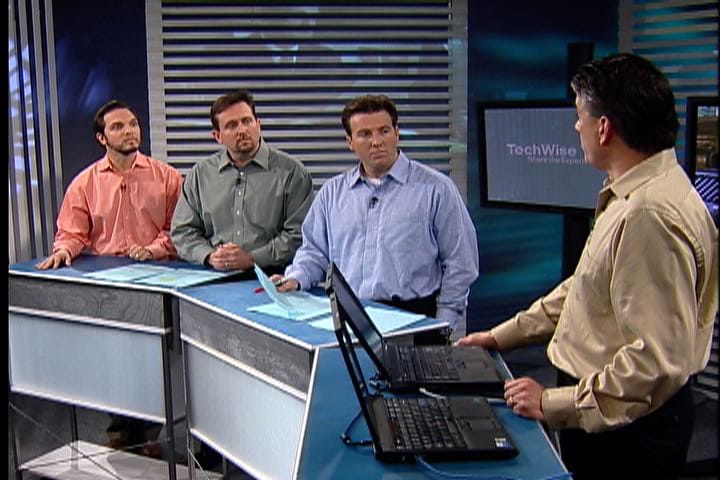
But getting genuinely good at explaining it — whiteboard-good — did something else for me. It got me noticed as someone who could take complex security concepts and make them land for technical audiences. By 2006, that reputation had traveled far enough that I was selected to help launch something new at Cisco called TechWiseTV. Security was my first series as a security overlay host. The terrified sales rep from Fort Worth had, somehow, become the person Cisco trusted to explain this stuff on camera.
I learned recently that Dr. Eric Cole passed away. He was around my age. I mention him here because TechWiseTV's first four episodes were security-focused — themed around the insider threat — and Eric was the external expert Cisco brought in to make sure we got it right. Putting field sales and engineering folks onto a video set doesn't automatically make good content. Eric was our ringer. He had the depth and the resume. We had the hunger. For a while we also had an actual TV host, Jonas Tichenor, to help us figure out what we were doing. All of it necessary. I owe a lot of my early on-camera confidence to the people Cisco surrounded me with in those first months. Eric Cole was one of them.
The Promise That Outran the Technology
When the Self-Defending Network campaign launched in 2004, I understood the instinct behind it immediately. CSA — the kernel-level interception work I'd been evangelizing — was one piece of what should have underpinned a network that defended itself. But it was only one piece. The campaign was broader than any single product. Cisco was assembling a vision that included network design, dedicated security appliances, endpoint protection, and unified policy management — all tied together through what the industry would have called marchitecture at the time.
The friction was everywhere. Getting protection to every endpoint required an agent on every machine. And the network fabric itself — the switches and routers that everything actually ran on — was still being treated as implicitly trustworthy. Nobody was asking hard questions about what happened if the infrastructure layer was the attack surface.
That wasn't negligence. It was how the industry thought. The network was hardened, patched on a schedule, and assumed safe between patches. Security operated in layers alongside the network, not inside it.
Worth noting: much of this predates the vocabulary we now take for granted. John Kindervag — who, as it happens, worked at one of the channel partner organizations I supported in my overlay role — didn't coin the term "Zero Trust" until around 2010. The idea of flipping our baseline trust assumptions, of treating the network itself as untrusted, was still forming. We were building security architecture on top of an infrastructure we fundamentally assumed was on our side.
That assumption would hold for another two decades.
What Changed
Big ideas in technology have a way of outlasting the moment they were born into. The principle behind Okena's StormWatch — intercept at the point of execution, enforce behavior rather than chase signatures, don't rely on knowing the attack in advance — was always correct. The limitation was where you could deploy it and at what cost.
Two things changed that equation.
First, the network infrastructure itself evolved. Modern data center switches like Cisco's Nexus line moved away from monolithic proprietary operating systems to modular, Linux-based ones like NX-OS — which means they have real kernels, programmable policy enforcement, and the ability to run logic that IOS simply wasn't built for. The "endpoint" that Okena was protecting in 2003 was a desktop or server. In 2026, the switch OS is an endpoint too.
Second, the technology for kernel-level enforcement matured dramatically. eBPF — Extended Berkeley Packet Filter — largely solves the deployment problem that constrained CSA. You don't install a separate agent. You don't modify the kernel's source code. You don't reboot anything. eBPF runs verified, constrained programs inside the kernel dynamically, at runtime, with very low overhead. The friction that made StormWatch a hard sell is mostly gone.
Cisco didn't stumble onto this. They went and bought the team that built it.
The Isovalent Acquisition, Decoded
Cisco acquires a lot of companies — hundreds over the years. The playbook is recognizable: find the right architectural idea in a small team, absorb the engineers, thread the technology into the product line. What made the Isovalent acquisition in late 2023 different wasn't the structure. It was what came with it.
The surface-level read was that this was a Kubernetes play — Isovalent built Cilium, one of the most important eBPF-based networking layers for cloud-native environments, and Tetragon, the runtime security enforcement engine built on top of it.
That framing was accurate but incomplete.
Isovalent was one of the small number of teams that actually proved eBPF could be used as production infrastructure, not just as a tracing trick. Thomas Graf, Dan Wendlandt, and the core team had done that work alongside hyperscalers — Google uses it, Netflix uses it, Cloudflare uses it — at a scale and overhead profile that made it credible for enterprise deployment. What was unusual was the idea of carrying that model into the operating system of enterprise network infrastructure itself.
The verifier and sandbox architecture at the heart of eBPF was engineered into the Linux kernel by Alexei Starovoitov and Daniel Borkmann. What Isovalent recognized — coming from deep Linux kernel and SDN backgrounds — was that this architecture addressed a problem the security industry had struggled with for twenty years: how to get enforcement into the kernel without owning the kernel's failure modes. They didn't invent the lock. They were the first to understand what door it could open.
Why the Kernel Is Both the Goal and the Problem
The kernel is the most powerful place in any operating system. It's also historically the most dangerous place to work.
Security vendors have known this for decades. Get your enforcement logic into the kernel and you can see everything — every packet, every syscall, every process. But you're also one bad update away from owning the whole machine. That's not a hypothetical. That's July 19, 2024.
When CrowdStrike pushed a faulty content update to its Falcon security agent, it took down an estimated 8.5 million Windows machines globally — airlines, hospitals, banks, broadcasters, all at once. The root cause wasn't the bug itself. It was where the agent ran. Falcon operated as a kernel module, which means it had full, unrestricted access to the OS. When the update had a flaw, the entire operating system went down with it. Blue screen. Unbootable. No recovery without human hands on keyboards.
The alternative security vendors traditionally reached for was user space — running enforcement logic outside the kernel, in a layer the OS could contain if something went wrong. Safer for the system, yes. But user-space agents can't see kernel behavior in real time, can't enforce at the speed packets move, and can be bypassed by anything operating beneath them. You traded power for safety and ended up with neither.
eBPF breaks that tradeoff. Enforcement programs don't run as kernel modules. The kernel itself verifies them before they ever execute — checking for loops, illegal operations, memory violations — and then runs them under enforced constraints. They can observe and act on kernel behavior from inside the kernel, but they operate in a very different risk category from unrestricted kernel modules. An unsafe eBPF program should be rejected at load time by the verifier. It doesn't get the chance to take the machine with it.
That's not a minor distinction — and it's why CrowdStrike isn't just a cautionary tale. It's the clearest possible argument for why eBPF's architecture matters.
What This Looks Like in Practice
Cisco's first major product expression of this was Hypershield, announced in April 2024 — just months after the Isovalent acquisition closed. That timing was not coincidental. Cisco had clearly been building toward this in parallel, and the acquisition was the technical foundation that made the announcement credible. Cisco's own materials tie Hypershield and Live Protect directly to Isovalent's Tetragon and eBPF work — the acquisition wasn't just inspiration, it was the engineering.
Hypershield isn't one thing running in one place. It comes in multiple enforcement form factors. The Tesseract Security Agent runs on endpoint servers and interacts with the OS kernel via eBPF. Virtual and container enforcement points run inside VMs or containers close to the workload. And the architecture is designed to sink progressively deeper into hardware over time.
Cisco's public direction is staged: start with software enforcement where eBPF is most mature, then move progressively toward DPUs, hardware accelerators, and network devices. The software-first launch was a beachhead, not the end state. The end state is enforcement embedded at every layer — server, NIC, switch port — all managed from a single policy plane. Security placed in every application service in the datacenter, every Kubernetes cluster in the public cloud, every container and VM. That's the "fabric, not a fence" framing Cisco keeps returning to.
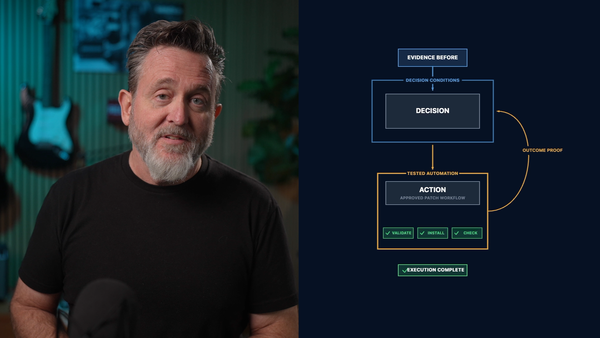
And then there's the update architecture, which I think is underappreciated. Hypershield introduced a self-qualifying update system where security policies are tested against live production traffic before deployment. The system validates its own patches before rolling them out. That's not a feature. That's a different philosophy about how security software should work.
Live Protect: The Moment That Closed the Loop
The announcement that brought all of this into focus for me — unveiled at Cisco Live last week — was Live Protect.
Live Protect embeds Tetragon — Isovalent's eBPF-based runtime security engine — directly into Cisco NX-OS on Nexus switches. Cisco describes it as the first enterprise-grade Tetragon agent built directly into a network operating system, starting with NX-OS 10.6(1)F. When a vulnerability is disclosed, an administrator sees it flagged in the Nexus dashboard. One button applies a compensating control — scoped to a specific process, a specific file — without rebooting the switch, without modifying running binaries, without disrupting traffic.
That is the Okena whiteboard. Same principle, twenty-three years later, running inside the infrastructure itself.
The lineage isn't code lineage — it's architectural lineage. Move enforcement closer to execution, act before the dangerous operation completes, define behavior instead of waiting for signatures.
To make it concrete: Copy_Fail is a Linux kernel privilege escalation vulnerability — high severity, exploitable with a very small Python proof of concept, and present across a very broad range of Linux kernels and enterprise distributions. Tetragon's approach is surgical. Block any process that attempts to open an AF_ALG socket. Applications keep doing everything they normally do. The one system call this exploit requires simply cannot complete. The attack is neutralized at the kernel level, in real time, before privilege escalation occurs — no patch, no application disruption, no maintenance window.
That's what "runtime protection" means in practice. Not a signature. Not a scan. A behavioral policy enforced at the point of execution, with full context of what the system is actually doing.
Why AI Makes This Urgent Right Now
An AI inference cluster running at scale doesn't have maintenance windows. It runs continuously, moves enormous volumes of sensitive data, and operates at a pace where human response times are simply insufficient. The network fabric underneath it — the switches carrying traffic between GPU nodes — has historically been the one layer nobody was actively protecting at runtime.
Live Protect's no-reboot, no-binary-modification approach isn't a convenience feature. It's the only model that actually works when downtime isn't an option.
Is This a Real Moat?
Yes — but with conditions worth understanding.
The underlying technology is open source. The moat isn't the technology. It's the architects who built it, the enterprise distribution to deploy it at scale, and the fact that they applied it to network infrastructure nobody else thought to protect.
I haven't seen Arista or Juniper make a comparable public claim: embedded eBPF/Tetragon-style runtime enforcement inside the switch OS with CVE-specific compensating controls. Closing that gap would be a multi-year engineering commitment for anyone starting from scratch.
The risk isn't a competitor out-innovating Cisco. It's Cisco out-complexifying themselves — taking something genuinely sharp and burying it inside procurement and integration processes that slow adoption.
Full Circle
I've been thinking about this for a long time — longer than I realized until last week.
The whiteboard pitch I was giving in 2003 about Okena's architecture. The Self-Defending Network campaign I watched launch in 2004, which I always believed in even when the technology wasn't quite there yet. The twenty years of watching security and networking evolve in parallel, never quite converging the way they should have.
And then, in a briefing at Cisco Live, watching eBPF enforcement run inside NX-OS on a Nexus switch, compensating controls applied without a reboot, the actual architects of that technology now inside Cisco deploying it at every layer of the stack.
The Self-Defending Network wasn't a failed idea. It was an early one. That's a very different thing.
Robb Boyd spent nearly two decades at Cisco as Managing Editor of TechWiseTV — the company's highest-ROI marketing asset, reaching audiences in 65+ countries. Today he helps technology companies close the gap between their engineers and everyone else: customers, executives, and the broader audiences that actually move markets. If your technical experts have something important to say but struggle to say it in a way that lands, that's the problem Robb solves — through hosted video series, guided narrative content, and on-camera work that makes complex ideas clear without making them simple.
Want more analysis like this? Subscribe to ExplaiNerds. And if you're a marketing or content leader with a story that deserves a bigger audience — let's talk.