Cisco Bought a Lie Detector and a Bouncer for AI — In the Same Week
Cisco acquired a hallucination detector and an AI identity cop in the same week. That's not a coincidence — it's a platform bet on who governs the agentic enterprise.

Back in January, I wrote that Cisco was busy "Cleaning the Garage." Sweeping out legacy cobwebs, consolidating the Splunk data hoard, making sure the enterprise plumbing could handle a flood of AI traffic without bursting a pipe.
The garage is clean. The Splunk data lake is full. And Chuck Robbins just backed two moving trucks into the driveway — on back-to-back days.
Cisco's intent to acquire Galileo (announced April 9) was the first piece of high-end furniture moving into the AI house. Then came reports of advanced talks to acquire Astrix Security — a Tel Aviv-based startup laser-focused on the identities those AI agents carry.
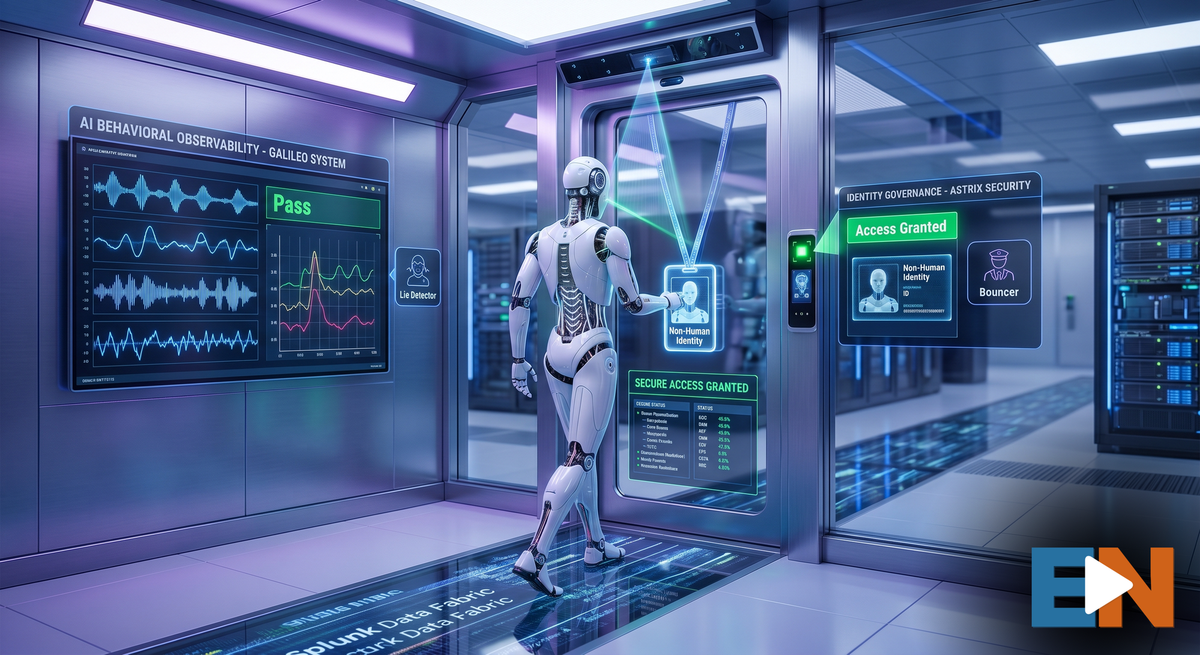
Galileo is the polygraph machine. Astrix is the velvet rope. Together, they're something Cisco has been systematically building toward: a genuine AI Foundation — not just for performance, but for governance.
From "Is It On?" to "Is It Sane?" to "Should It Even Be Here?"
Historically, Cisco made its bones telling you whether a packet got from Point A to Point B. Later, with AppDynamics and Splunk, they told you how fast it got there and whether the server was on fire.
But as we enter the era of the Agentic Workforce, those old metrics are already becoming legacy artifacts. The failure modes have changed completely:
- Old World: "My database is down! Everyone panic!"
- New World: "The AI Agent just hallucinated a 40% discount for a customer in New Jersey, and now we're technically a non-profit."
- The New New World: "Wait — which AI agent? What permissions did it have? Who authorized it? Does it have access to our payroll system too?"
Traditional observability is great at detecting a heart attack (system failure). It's terrible at detecting a delusion (AI hallucination). And it's completely blind to whether an autonomous agent should have had access to your systems in the first place.
Galileo is the psychiatrist for the machine. Astrix is the identity officer at the door.
Galileo: The Black Box Gets a Co-Pilot
The $28 billion Splunk acquisition always had an obvious strategic logic — unify data, telemetry, and observability into a single platform that could see everything happening across an enterprise. What was less clear was how that platform would evolve once AI agents became first-class citizens inside that environment. This is the answer.
If Splunk is the "Black Box" flight recorder that tells you why the plane crashed, Galileo is the Co-Pilot that taps the pilot on the shoulder and says, "Hey, that's a mountain, not a cloud," before the impact.
By plugging Galileo into the Splunk Observability Cloud, Cisco is building a Trust Layer for the entire Agent Development Lifecycle. As Kamal Hathi (SVP at Splunk) put it, this adds "enterprise-grade rigor" to AI operations — monitoring not just if the AI is talking, but whether it's talking sense, leaking your secret sauce, or being a jerk to customers.
They didn't try to build a better LLM. They bought the guy who grades the LLM's homework and flags the cheaters.
Astrix: The Agent Has an Identity Problem
Here's the thing that doesn't get enough attention when we talk about AI agents: every one of them carries credentials. API keys. OAuth tokens. Service accounts. Machine identities that grant access to internal systems, external services, and sensitive data.
Zeus Kerravala of ZK Research — who has been tracking the shift toward AgenticOps as a distinct operational discipline since MWC Barcelona earlier this year — puts it cleanly: Galileo focuses on what the agent is doing, Astrix zeroes in on who or what has access. Its platform automatically inventories non-human identities across an enterprise environment, maps their permissions, detects dangerous combinations, and remediates over-privileged access before it becomes a breach.
Think about the scope of that problem. A coding assistant with admin-level database credentials. An AI scheduling agent with write access to financial systems. A customer service bot with the ability to modify account records. Most organizations deploying agents right now have no centralized visibility into what those agents are actually authorized to do.
Astrix was already trusted by Fortune 500 companies including Workday, NetApp, and Figma. The team — founded by veterans of Israel's elite Unit 8200 intelligence unit — proved their technical depth in 2022 when they discovered GhostToken, a zero-day in Google Cloud Platform that allowed malicious OAuth applications to hide permanently inside Google accounts. That's not a typical startup resume.
The Sovereign Angle — And Why It Actually Matters
Let me explain why I keep using the word "sovereign" in this context, because it's not jargon — it's a requirement.
For most of the cloud era, "securing AI" meant sending data to someone else's platform for validation, analysis, and remediation. You'd pipe your telemetry out, get a report back, and hope nothing sensitive leaked in transit. That's fine when your data is generic. It's untenable when your data is a competitive asset, a regulated record, or a national security concern.
Sovereign AI infrastructure means your governance happens inside your perimeter. The audit trail doesn't leave the building. The hallucination detection runs on-premises. The identity controls are enforced by your network — not outsourced to a SaaS dashboard you don't fully control.
Galileo and Astrix, integrated into Cisco's existing stack — Splunk, Hypershield, Zero Trust, the network fabric itself — make that possible. This is exactly the gap I've been tracking since my Sovereign Critical Infrastructure work. And it extends further than security and observability.
Cisco's Webex team is making the same argument for collaboration. On April 30, I'm hosting a LinkedIn Live with the Webex team diving into their Collaboration AI Pods architecture — a design that brings the full Webex AI Assistant, Agentic Workflows, and Real-Time Intelligence on-premises, so your data stays under your roof and your models stay under your governance. Different product surface, same thesis: AI innovation doesn't require surrendering control.
What happens in the data center stays in the data center. For a growing list of enterprises, governments, and critical infrastructure operators, that's not a feature. It's a requirement.
One Week, Two Deals, One Very Clear Signal
Let's call this what it is. In 48 hours, Cisco announced:
- Galileo — AI behavioral observability, hallucination detection, prompt security, integrated into Splunk
- Astrix (~$250–350M, per reports) — Non-human identity governance, agent permissions management, integrated into Zero Trust
As Holger Mueller of Constellation Research noted, the rules of observability have fundamentally changed. Cisco spent decades securing the network. Now they're securing the thought process — and the identity — of every autonomous system running on top of it.
AI Trust=Observability (Galileo)+Identity (Astrix)+Data (Splunk)
This isn't experimentation. This is a platform bet. Cisco is building the control plane for the agentic enterprise — the layer that sits between AI agents and the rest of your infrastructure, asking two questions before anything moves: Is this agent behaving correctly? And should it have access to any of this in the first place?
What This Means Right Now
For enterprise IT: You finally have a vendor-backed answer to the question your CISO is about to ask: "How do we actually govern these things?" Cisco is assembling that answer faster than anyone else in the stack.
For the C-Suite: This is the kill switch you've been waiting for. Not a theoretical framework — actual tooling that lets you audit, constrain, and shut down agent behavior in production.
For everyone watching Cisco's trajectory: We're not just moving from "Connecting Everything" to "Governing Everything That Thinks." We're moving toward a world where the network itself enforces AI accountability. That's a bet worth watching very closely — and one Cisco is now placing with real money.
Robb Boyd spent nearly two decades at Cisco as Managing Editor of TechWiseTV — the company's highest-ROI marketing asset, reaching audiences in 65+ countries. Today he helps technology companies close the gap between their engineers and everyone else: customers, executives, and the broader audiences that actually move markets. If your technical experts have something important to say but struggle to say it in a way that lands, that's the problem Robb solves — through hosted video series, guided narrative content, and on-camera work that makes complex ideas clear without making them simple.
Want more analysis like this? Subscribe to ExplaiNerds. And if you're a marketing or content leader with a story that deserves a bigger audience — let's talk.