The Best Question Nobody Wants to Ask
Two conversations happened before this episode that most people never see. One was two nerds troubleshooting echo cancellation. The other was a sales expert asking an uncomfortable question nobody had bothered to slow down and answer. Both made the show.

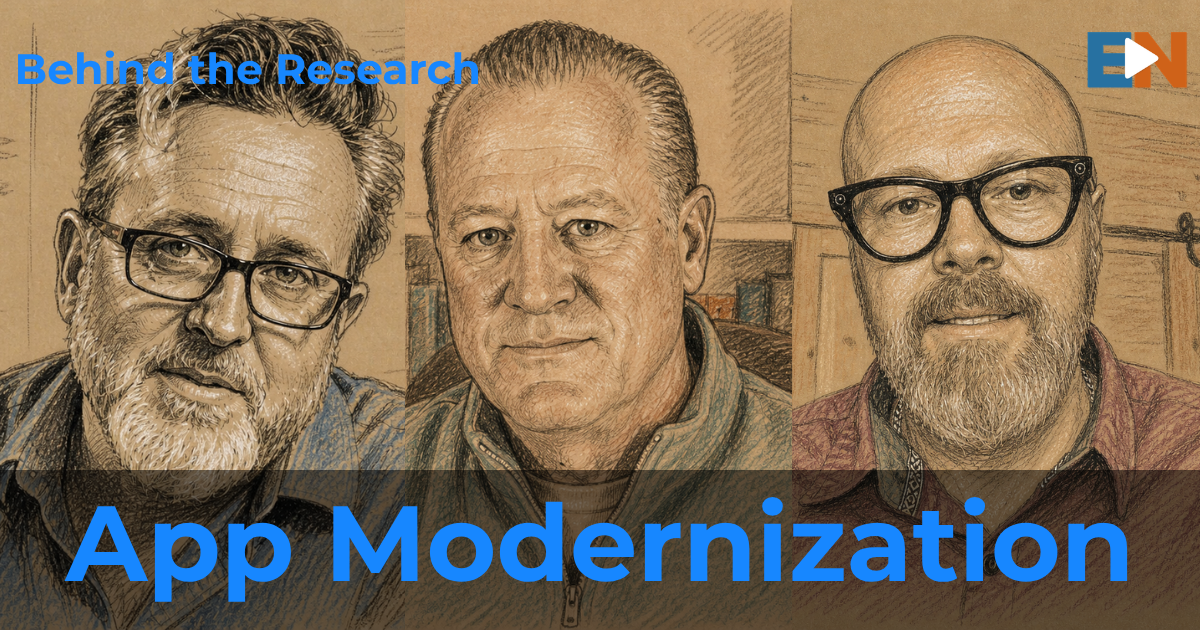
I'm going to tell you about a conversation that almost didn't happen — and about an hour that looked like a waste of time until it wasn't.
The Echo Problem
Todd Barron is a Principal Solutions Architect at WWT. He's also, as it turns out, exactly the kind of engineer who has strong opinions about audio routing.
Before we ever got Dave Sellers into a recording session, Todd and I met privately to work through how we'd actually capture him remotely. He relies significantly on closed captions to follow fast-moving conversation, which immediately put Riverside — our recording platform of choice — in an awkward spot. Riverside's captions aren't built for someone who needs them to work, not just exist.
So we started experimenting. Run Microsoft Teams alongside Riverside for real-time captions? Good in theory — until we realized that muting the mic to eliminate echo would also kill the audio feed Teams was using to generate the text. Leave the mic open? Echo. There went that plan. We tried Google Meet, which genuinely has exceptional real-time transcription, but running two video applications simultaneously created its own chaos.
We landed, eventually, on the simplest possible solution: his iPhone propped next to him, running the native transcription feature, listening to the room. Not elegant. Completely functional.
What made the session work wasn't the technology — it was that Todd already spoke the language. Mac user. Media-curious. The kind of person who has already thought about input sources and speaker routing as a matter of personal interest, not professional necessity. When I said "I think the echo is coming from this input," he knew immediately what I meant. We weren't troubleshooting a limitation. We were two people who enjoy this kind of puzzle, working one out together.
There's a principle underneath that I find myself applying constantly: the setup conversation isn't overhead. It's where you find out whether someone is going to be able to be themselves on camera — or whether they're going to spend the whole recording managing around something you didn't bother to solve in advance.
We also spent a few minutes on eyeline. This is something I deal with on every remote recording — most guests look at their own video feed or at the interview window, not at the camera, and it shows. Todd's situation made it impossible to ignore, since the caption display pulled his attention to a specific part of the screen. We talked through options. It wasn't fully solved, but naming it meant he was thinking about it consciously rather than just defaulting to whatever felt natural.
Once we actually recorded, his hearing was a non-issue. The prep work had done its job.
The Annoying Questions
The discovery call with Dave Sellers was one of the more valuable hours I've spent in pre-production — partly because it started badly.
Dave is a Cloud Sales Specialist at WWT. I'd worked with him before, and I knew he's sharp, direct, and not shy about saying when something isn't landing. About fifteen minutes into our call, after I'd laid out the focus — Priority 2 of WWT's Cloud Priorities research, Application Modernization — he basically stopped the meeting.
What are we actually trying to say?
And then he made it worse: he offered three different definitions of "modernization" in quick succession, each one legitimate, none of them the same. Containerizing a legacy monolith. Putting a new user interface on a solid backend so new employees don't need a month of training. Rebuilding from scratch to take advantage of AI. He'd seen clients pursue all three and call it the same thing.
I'll be honest: in the moment, I was a little annoyed. We had an hour. He was burning through it on a definitional debate that felt like it was pulling us away from the research paper, which already had clear frameworks and a specific scope.
But here's what I realized, maybe twenty minutes later: Dave wasn't being difficult. He was telling me exactly what his clients tell him. The confusion in that room was a direct mirror of the confusion in every conversation he has with a CIO who has just gotten a large cloud bill and wants to know what to do about it. "Modernization" means something different to every person at that table, and if you don't slow down to establish common ground before you start moving, you end up going very fast in several directions at once.
That realization changed how I built the script.
I didn't fight his instinct. I found places for it. Dave's broader point — that modernization can legitimately mean a UI refresh for some organizations — made it into Segment 2, where he gets to say it directly: "modernization could be containers, it could be a better UI, it could be a complete rewrite." But the narration around it redirects to the research's more disciplined framing: start with business objectives, not technology preferences. His field experience and the research structure ended up working together rather than against each other.
Later in the episode, his sales instinct comes through even more cleanly in the Segment 4 moment where he talks about sitting down first to create business objectives — "which ones are important, which go first, second, third." That's not abstract. That's exactly how he talks to clients. And it lands in the exact right place structurally: after the temptation to just buy AI tools and call it transformation, his voice arrives as the practical corrective.
There's something worth naming about how these calls work. There are usually several people in the room — marketing leads, program managers, client-side stakeholders — and not all of them are deep into the technical subject matter. That's not a criticism; it's just the reality of how these things get organized. What it means in practice is that the editorial direction often can't be put to a group vote. Someone has to hold a line and make judgment calls about what serves the episode — even when the room is full of smart people with different instincts about what "good" looks like.
Dave's questions were actually the most useful input I got. His confusion was diagnostic. His instinct to broaden the definition turned out to be the key to making the episode feel real rather than scripted.
What the Video Gets Into
The full conversation with Dave and Todd covers the entire Priority 2 framework: why lift-and-shift without modernization produces a financial trap, how to think about portfolio disposition, what AI-native engineering actually means versus what most organizations think it means, and why the window for doing this work on your own terms won't stay open indefinitely.
Todd's "dumpster fire on premise will be a dumpster fire in the cloud" line is probably the most quotable moment. Dave's "fundamental business mistake" framing near the close is the one that should make executives uncomfortable in a productive way.
But the argument underneath all of it — the one that finally emerged from that wandering discovery call — is simpler: this isn't really about cloud costs. It's about organizational ceilings. Legacy applications don't just carry technical debt. They carry a limit on how fast you can move when the market requires you to move fast.
Once we agreed on that, everything else locked into place.
Watch the full conversation with Dave Sellers and Todd Barron on the WWT Research platform. The Cloud Priorities for 2026 research paper goes deeper on every dimension of Priority 2 — the disposition framework, cloud-native design principles, and the metrics that tell you whether your modernization work is moving the right numbers.
Robb Boyd spent nearly two decades at Cisco as Managing Editor of TechWiseTV — the company's highest-ROI marketing asset, reaching audiences in 65+ countries. Today he helps technology companies close the gap between their engineers and everyone else: customers, executives, and the broader audiences that actually move markets. If your technical experts have something important to say but struggle to say it in a way that lands, that's the problem Robb solves — through hosted video series, guided narrative content, and on-camera work that makes complex ideas clear without making them simple.
Want more analysis like this? Subscribe to ExplaiNerds. And if you're a marketing or content leader with a story that deserves a bigger audience — let's talk.