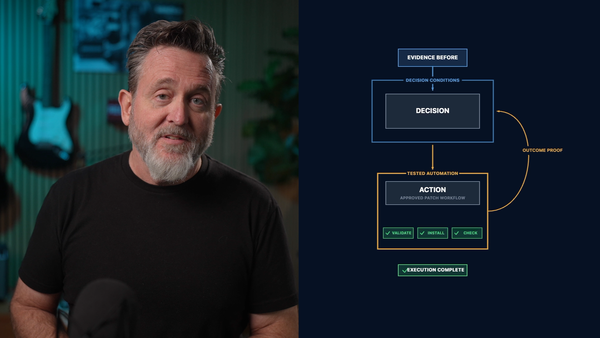
Six Months From Now, Will You Remember Why?
AI is helping organizations reach decisions faster. But when the conclusion survives and the reasoning disappears, they begin accumulating decision debt.


AI is helping organizations reach decisions faster. But when the conclusion survives and the reasoning disappears, they begin accumulating decision debt. The second in an ongoing series exploring AI’s impact on work and decision making.
Six months from now, your organization will probably still know what it decided.
The purchase order will still be in the system. So will the escalation, the hiring recommendation, the revised forecast, and the policy somebody approved.
The harder question is whether anyone will still remember why.
Organizations are generally good at preserving outcomes. We retain tickets, approvals, meeting summaries, documents, dashboards, and final recommendations.
What we preserve less reliably is the reasoning underneath them.
What information was available? Which assumptions mattered? What alternatives were rejected? Where was the uncertainty? Who ultimately exercised judgment?
AI is making that gap more consequential.
It can analyze information, summarize evidence, recommend an action, and help move work forward. But the path that produced the answer may remain scattered across temporary prompts, generated summaries, source material, and conversations that were never treated as part of the decision record.
The decision survives.
The reasoning becomes harder to recover.
That is the idea I explore in this video essay.
Rather than treating decision debt as another documentation problem, I think it represents something more serious: the growing distance between what an organization remembers doing and what it can still explain.
That debt may remain invisible until a decision has to be defended, reversed, audited, or learned from.
At that point, a plausible explanation is not enough. The organization needs the actual basis for the decision—and enough context to know whether that basis still holds.
I would love to hear where you see this happening in your own work. What parts of the reasoning process are most likely to disappear after the decision has been made?
This is the second in a series of short video essays exploring how AI is changing organizations, judgment, and professional value.
Key ideas
- Organizations often preserve decisions more reliably than the reasoning behind them.
- AI can accelerate analysis while fragmenting the record of how a conclusion was reached.
- Decision debt becomes visible when a decision must be defended, changed, audited, or revisited.
- A plausible reconstruction of the past is not necessarily an accurate decision record.
- Preserving the “why” requires capturing evidence, assumptions, alternatives, AI involvement, and accountable human judgment.
The term decision debt came to me through Terri Coles’ reporting for No Jitter. Her article examines how AI-supported decisions can outlive the context, authority, and human judgment behind them.
This essay is part of an ongoing series exploring how AI is changing organizations, decision making, and professional value. Rather than concentrating on model releases or product announcements, I am interested in the slower changes: the assumptions, signals, and working practices that may no longer function the way they once did.
Source and further reading
Terri Coles, “AI at work is creating decision debt. Can your organization still explain its own decisions?” — No Jitter
Coles’ reporting helped give me a name for the problem explored here. The article also cites research from Frank Melke and contraco involving 247 organizations across 12 industries, finding that fewer than one in five could state precisely what their AI agents were authorized to do.
The larger issue is not simply whether organizations are using AI. It is whether they can still reconstruct the authority, assumptions, evidence, and human judgment behind the decisions those systems help produce.