Your Data Is Local. Your Brain Isn't.
Your hardware is on-prem. Your data never leaves the building. But during a 36-hour outage, everything stops. Why? Because the "brain" of your system is still tethered to the cloud. It’s time to move past the hybrid facade and find true sovereignty. Is your brain local?

There's a version of this conversation I've had more times than I'd like to admit. An organization runs the full sovereign-infrastructure play — hardware on-prem, contracts reviewed, compliance audit passed, the whole production. They come out the other side confident the sovereignty problem is solved. The servers are in the building. The lawyers are satisfied. The box is checked.
Then the internet goes down for 36 hours during a tabletop exercise. And a room full of people who've been nodding confidently for three years gets very quiet.
The hardware was local the whole time. The data never left the building. But the layer that controls what the system does — user authentication, device provisioning, access control — had been quietly calling home to a cloud service outside their perimeter every single day. Not because someone made a bad decision. Because nobody asked the question that would have surfaced it during procurement.
The analyst community is finally putting a name to this ghost in the machine.
The Industry is Catching Up
A Network World piece by Taryn Plumb dropped recently that’s worth your time: Cloud-first vs. sovereign-first: Navigating the trade-off. Gartner, Forrester, and Info-Tech are all weighing in on why enterprises are treating sovereignty as an operational necessity rather than a compliance checkbox. They cite the "weaponization of IT," the Cloud Act, and Microsoft acknowledging on record that it can't always guarantee customer data will remain within national borders.
It's a well-sourced piece, and the problem is correctly identified. It’s also mostly about where your data lives, which turns out to be only part of the problem.
The article quotes a Forrester analyst saying there is "no legislation whatsoever in the world" that defines what sovereignty is and isn't. That's true, and it's also exactly why location-first thinking creates a false sense of security. A server rack in your building with a management layer that depends on an outside connection isn't sovereignty — it's a convincing facade. The hardware is real. The autonomy is decorative.
The Management Plane: The Invisible Tether
There are three layers in any collaboration infrastructure, and only two of them tend to show up in the sales conversation.
- The Data Plane: Where media flows—your video, audio, and screen shares.
- The Control Plane: Handles the "traffic lights"—routing, encryption, and bandwidth management.
- The Management Plane: This is the "Brain." It handles orchestration—user provisioning, policy enforcement, device configuration, and monitoring.
The Management Plane rarely makes the pitch deck. It’s hard to explain in a 30-minute meeting, and if everyone understood it fully, procurement would get a lot more awkward. But it is the layer that determines whether you're allowed to make a call at all.
You can own the hardware and keep your video traffic entirely local, but if your Management Plane phones home to a cloud service for authentication, you are tethered. Everything works perfectly as long as you're connected. But if you’re building for sovereignty, "connected" is an assumption you can no longer afford to make. The moment that external dependency breaks, your infrastructure dies. Not because the hardware failed, but because the brain was never actually in the room.
The Question That Breaks the Room
Forget the architecture diagram. Here is the test that cuts through the marketing:
"If we lose internet access right now, what stops working?"
If anything in your communications infrastructure stops working — not degrades, but stops — you don't own a system. You've leased a service that happens to live on your property.
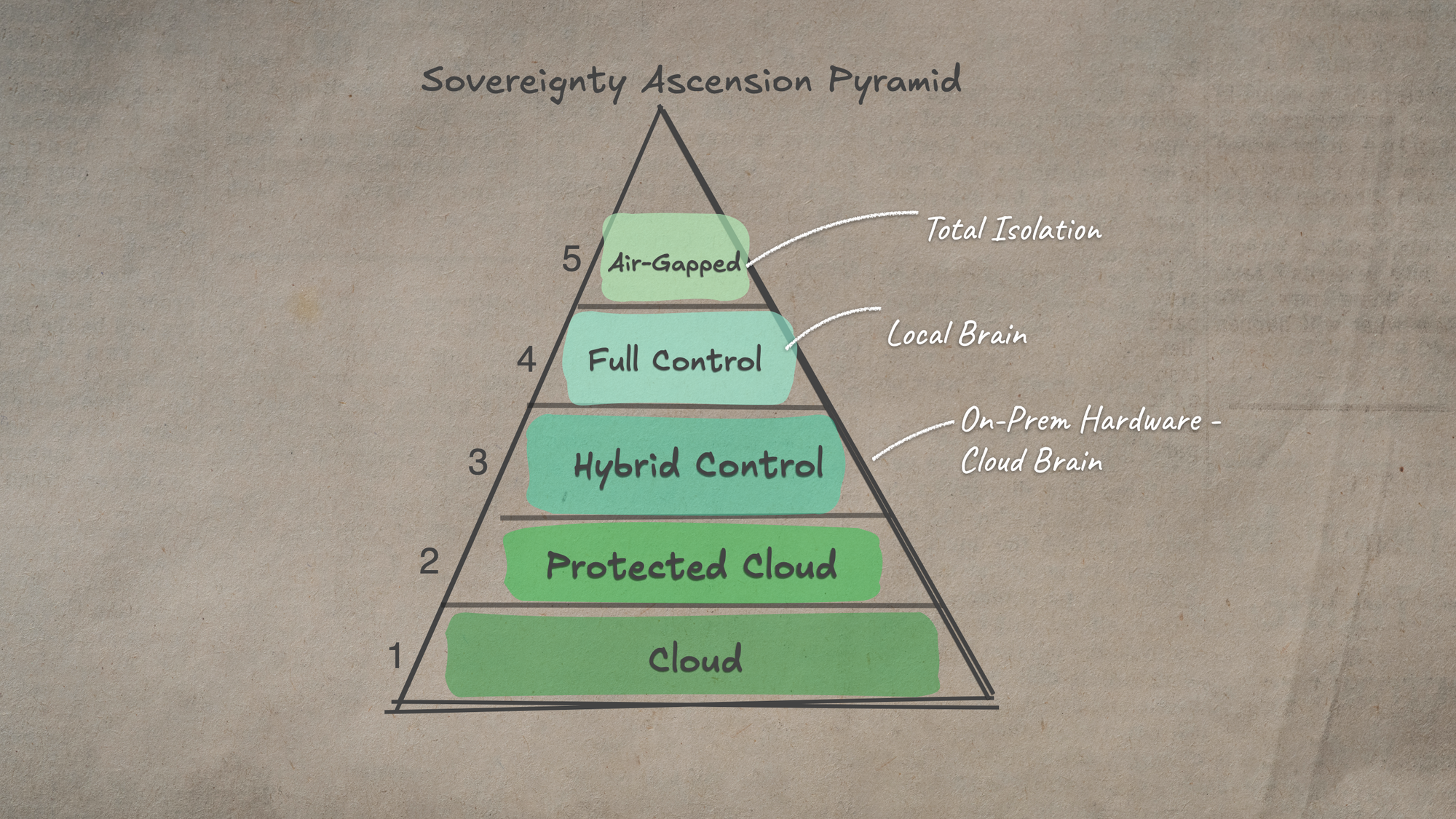
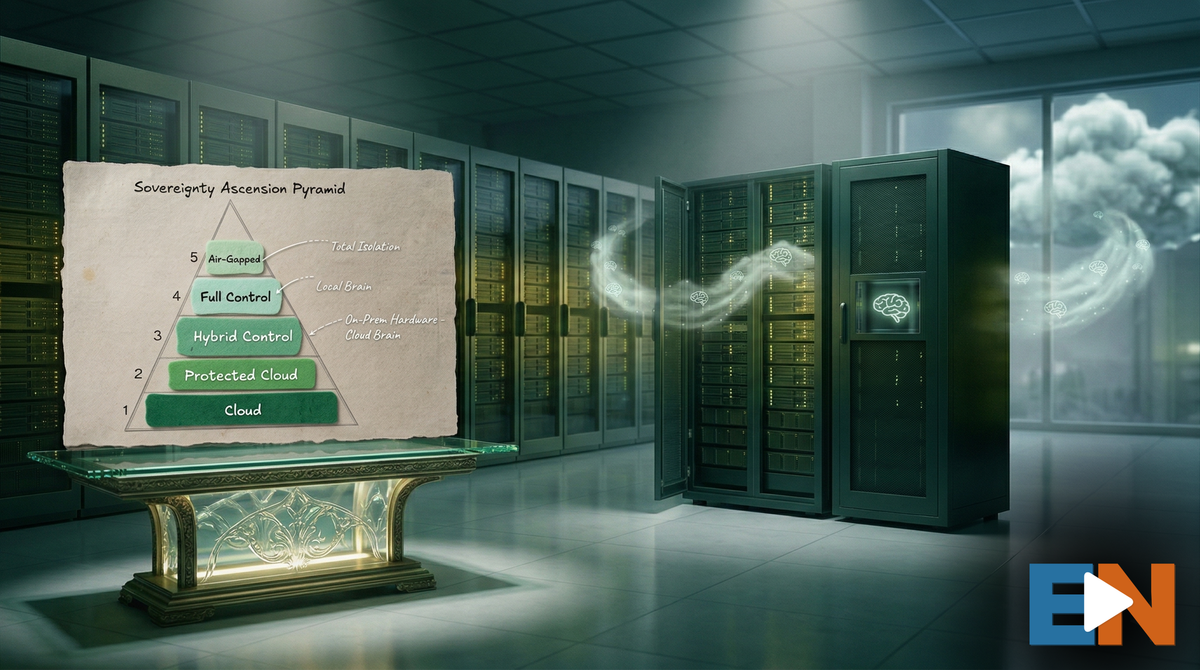
To help organizations locate themselves, I use what I call the Sovereignty Ascension Pyramid:
- Level 5: Air-Gapped. Air-gapped. Zero external dependencies.
- Level 4: Full Control. The "Brain" is local. All three planes live on your infrastructure.
- Level 3: Hybrid Control. Data is local, but the Management Plane is cloud-tethered. (Most orgs live here thinking they are at Level 4).
- Level 2: Protected Cloud. Data stays in-country, but on someone else's hardware.
- Level 1: Cloud. Fully off-site, fully dependent.
The Network World piece is right that sovereignty involves genuine trade-offs. What it doesn't offer is a way to locate yourself on that spectrum with precision. The question above does that in about 30 seconds.
Closing the Gap
Identifying the gap is the hard part; closing it is the technical part. This is where I’ve been spending my time lately, working on a video series with VQ Conference Manager. They’ve been solving for "Level 4 and 5" problems since long before the analyst community caught up.
When Cisco's TelePresence Management Suite (TMS) reached end-of-life, it left a massive vacuum for air-gapped and high-security environments. VQ and Cisco built the answer together: a sovereign-capable management plane that lets organizations keep all three layers—data, control, and management—on their own infrastructure.
If you're currently staring at that vacuum, I highly recommend digging into the specifics. You can check out VQ’s Steve Holmes discussing the broader strategic benefits of this approach, or dive into the technical weeds with Jon English, who walks through exactly how to migrate without losing your mind in the process.
The organizations I'm profiling in this series aren't making the move because it's the "easy" cloud-first path. They're doing it because the "Internet Down" question told them a truth they didn't like, and they decided it was time to bring the brain back home.
Robb Boyd runs ExplaiNerds — a content studio that translates complex infrastructure and technology into stories that decision-makers can actually use. Follow along at explainerds.net.