Why Cisco Renamed DevNet to Automation
Cisco's DevNet rebrand to 'Automation' isn't cosmetic—it's positioning automation as a core discipline equal to routing and switching. The market already decided what to call these jobs. Cisco's certification naming finally caught up.


This already feels obvious in hindsight: Cisco just renamed its entire DevNet certification track to “Automation.”
DevNet Associate becomes CCNA Automation.
DevNet Professional becomes CCNP Automation.
DevNet Expert becomes CCIE Automation.
...same certifications, new (improved!) names.
Don't mistake this for simple rebranding - there's a bigger play happening here. Cisco is now positioning automation as a first-class discipline in enterprise networking.
The DevNet Problem
DevNet was a confusing brand. I just didn't realize it at first.
When Cisco launched it in 2014 under Susie Wee's leadership, it was visionary. They saw that networking was becoming software-defined, that APIs and programmability would matter, that network engineers would need to write code. They were ahead of the curve.
For a decade, DevNet built something special at Cisco Live—the flamenco dancers, the dueling pianos, the 4:30 beer parties, the packed booths where network engineers discovered they could code. That culture mattered. It signaled this was different—a maverick effort inside a traditional networking company, building community before anyone knew exactly what that community would become.
But here's what happened in practice: Hiring managers didn't understand what "DevNet" meant. Was it for developers? Was it for network engineers? Was it some hybrid role that didn't really exist yet?
Recruiters would see "DevNet Associate" on a resume and have to Google it. Candidates with DevNet Expert certifications—one of the hardest credentials in IT to earn—would show up at CCIE events and get turned away because "this is only for CCIEs."
The skills were valuable. The brand was ambiguous.
Meanwhile, job postings weren't asking for "DevNet professionals." They were asking for "Network Automation Engineers," "Infrastructure Automation Specialists," "NetDevOps Engineers." The market had already decided what to call these roles. Cisco's certification naming just hadn't caught up.
"Automation" Changes Everything
"Automation" is crystal clear. Everyone knows what it means.
When you see "CCNA Automation" on a resume, you immediately understand: this person can automate network tasks, work with APIs, write Python scripts, use infrastructure-as-code tools. No explanation required.
By folding automation into the CCNA/CCNP/CCIE hierarchy, Cisco is making a statement: Automation is not a specialty track. It's a core discipline, equal to routing, switching, security, and collaboration.
This matters because enterprises are finally realizing that network automation isn't optional anymore. Five years ago, automation was something forward-thinking companies experimented with. Today, it's table stakes for operating at scale.
Think about what's changed: AI workloads require constant network optimization that humans can't do manually. Multi-cloud deployments need consistent policy enforcement across disparate environments. Security threats move too fast for manual response. Business demands uptime and agility that manual change processes can't deliver.
Network engineers who can't automate are becoming obsolete. Cisco's rebrand acknowledges this reality.
Automation as a Core Discipline
You might be wondering: how does "Automation" sit on the same tier as disciplines like Routing or Switching? Isn't automation just something you add to those other skills?
That's the old mental model. Here's the shift: The CLI is no longer the primary interface for the network. The API is.
Think about scale. A senior engineer might manually manage 50-100 devices. Modern data centers run thousands of nodes. At that scale, manual configuration isn't just slow—it's the primary cause of downtime. Even the most perfect routing design fails when someone makes a typo on device number 427.
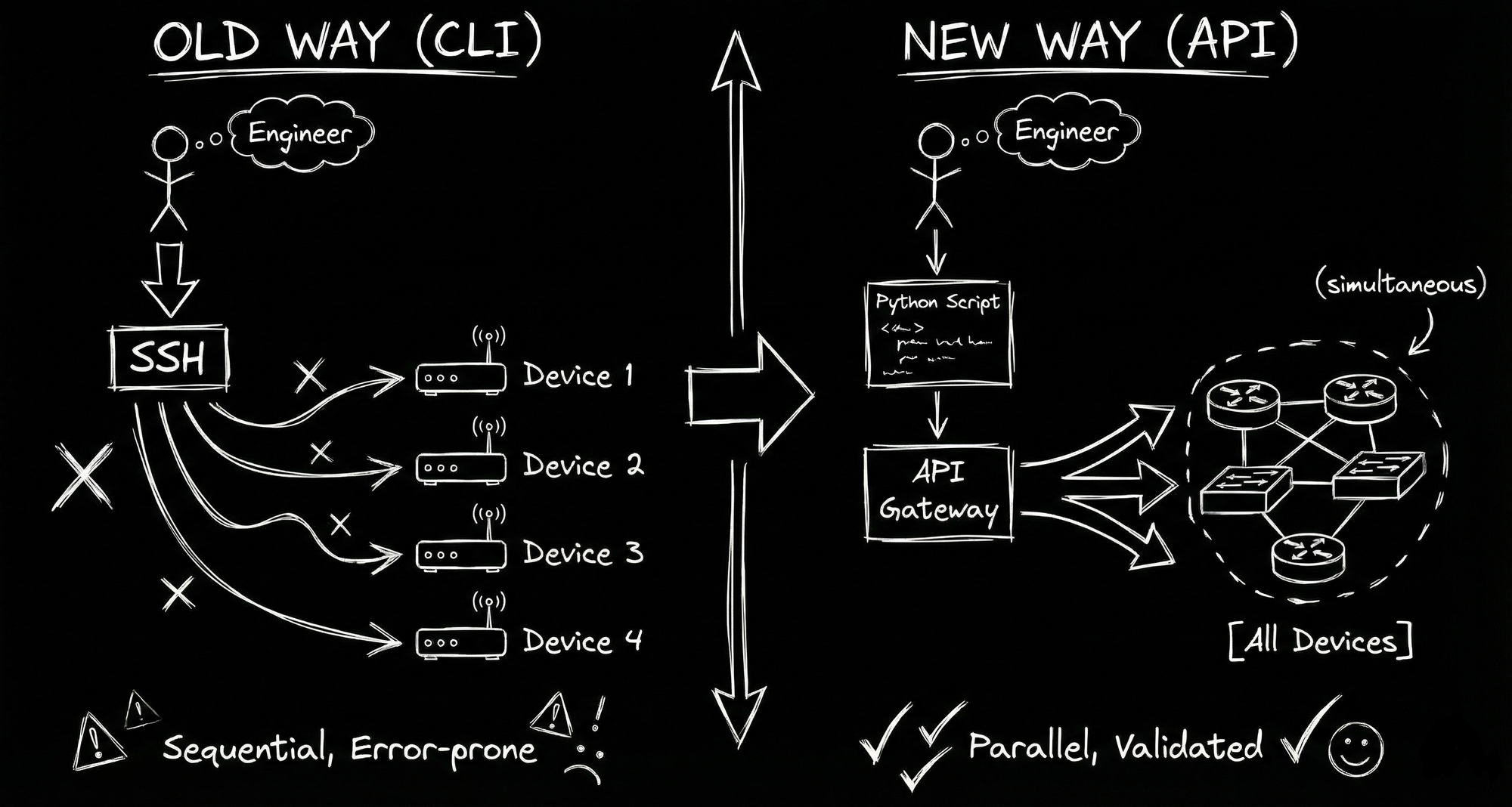
Routing manages the flow of data. Automation manages the flow of configurations. Without it, your network is a collection of individually-configured boxes. With it, the network becomes a single programmable entity.
This is why Cisco's repositioning automation as a core discipline rather than a specialty. Consider what changes:
From deterministic to event-driven: Traditional routing is deterministic—if X happens, the packet goes to Y. But modern networks need closed-loop automation: telemetry reports a congested link, logic analyzes the data, automation reconfigures the routing protocol in real-time. A CCIE-level engineer doesn't just configure OSPF anymore; they write the code that monitors and heals OSPF automatically.
From running-config to infrastructure as code: The old "source of truth" was whatever was running on the router. Now it lives in a Git repository. Routing and switching handle physical execution; automation handles version control, validation, and deployment. Configuration changes flow through CI/CD pipelines with automated pre- and post-checks. What used to take minutes per device now happens in seconds across the entire fabric.
From "how" to "what": At CCNA level, you learn APIs exist. At CCNP level, you use Ansible and Python to push configs. At CCIE level, you architect the entire network lifecycle. When automation is a "specialty," it's a luxury. When it's a "core discipline," it's a requirement for reliability.
By mastering automation alongside routing, you stop being the mechanic who fixes individual routers and become the systems engineer who ensures the network never fails due to human error.
That's not an add-on skill. That's foundational.
The Certification Overhaul
Look, I get it—name changes are exhausting, and sometimes it feels like technical education is 50% vocabulary updates. But this isn't just new labels. Cisco's using this transition to completely realign what the track actually teaches.
CCNA Automation (formerly DevNet Associate)
The foundation stays intact—Python, APIs, REST fundamentals. Rebranded February 3, 2026, but the blueprint doesn't change.
CCNP Automation (formerly DevNet Professional)
This is where it gets interesting. The core exam (AUTOCOR) gets a major blueprint revision that shifts the entire focus. It's moving from "network engineer learning to code" to "automation engineer building enterprise solutions."
The new emphasis: digital twins for pre/post-change validation, automation frameworks for operations and monitoring, end-to-end implementation. Translation: Less "can you write an app?" More "can you automate an entire network refresh without downtime?"
CCIE Automation (formerly DevNet Expert)
The lab exam itself isn't changing—same brutal 8-hour hands-on test of real-world automation scenarios. But now it carries 30+ years of CCIE brand recognition.
What's retiring:
Four specialist certifications (SAUTO, SPAUTO, CLAUTO, DEVOPS) phase out February 2, 2026. After that, automation skills get folded into the main enterprise and data center tracks.
The strategic message: Automation isn't a specialty you bolt on anymore. It's becoming table stakes across all networking domains.
The AI Integration Story
This connects to Cisco's broader transformation.
The CCNP Automation revamp is happening in parallel with Cisco's push into AgenticOps and AI-driven network operations. That's not a coincidence.
At Cisco Live 2025 in San Diego, the big reveal was AI Canvas—a platform for building network dashboards using Cisco's Deep Network Model, their purpose-built LLM for network operations. The vision is AI agents that can monitor, troubleshoot, and even remediate network issues autonomously.
But AgenticOps doesn't replace automation. It builds on top of it.
AI agents need APIs to interact with. They need programmable infrastructure to execute changes. They need automation frameworks to validate that their actions worked correctly. Without the automation foundation, AI in networking is just vaporware.
When the DevNet community was surveyed about what AI agents they want most, the top answers were configuration automation (37%), network monitoring (32%), and security and threat detection (22%). Only 9% wanted code generation.
Engineers don't want AI to write code for them. They want AI to help them operate networks more efficiently using the automation infrastructure they've already built.
The CCNA/CCNP/CCIE Automation track teaches the foundational skills. AgenticOps and AI Canvas are the next layer that leverages those skills at scale.
The Strategic Positioning
Let's zoom out and look at what Cisco's actually doing here.
Network automation used to be the domain of "that engineer who's good with Python"—a nice-to-have skill for special projects. Now Cisco's elevating it to CCIE-level status, putting it on equal footing with routing, switching, and security.
This repositioning works for everyone. Cisco gets a clearer story for its automation tools—NSO, Crosswork, Catalyst Center APIs—and a pipeline of professionals who can actually deploy them. Enterprises get an obvious career path for network engineers making the automation transition, plus a standardized way to evaluate candidates using the familiar CCNA/CCNP/CCIE hierarchy. And individuals? They get credentials that translate directly to job requirements and salary premiums—CCNP Automation professionals typically earn 30-50% more than traditional networking roles.
The real tell is what Cisco's retiring: those specialist tracks for collaboration automation, security automation, and service provider automation all sunset in February 2026. Instead, automation skills get folded into the core enterprise and data center paths. The message is clear—automation isn't a specialty anymore. It's a baseline expectation across every networking domain.
What This Means for Amsterdam
Cisco Live in Amsterdam next month is going to be interesting. The DevNet Zone—though I wonder if they'll actually rebrand the physical space—should be bigger than ever, and I'm expecting some substantive content beyond the usual product demos.
Look for customer stories with actual ROI numbers, not just "we automated some configs." Live demos showing how AgenticOps integrates with real automation workflows. New tooling around AI-assisted development and automation testing. Deep dives on brownfield automation—the messy reality of modernizing existing networks without ripping everything out and starting over. And plenty of guidance on navigating the new certification pathways, especially those AUTOCOR exam changes.
The hands-on labs will be mobbed. San Diego had 100+ person waitlists, and that was before the rebrand made the career path obvious. Engineers are figuring out that automation isn't a specialty skill anymore—it's the baseline that determines whether your career stays relevant or gets absorbed into someone else's Python script.
The Bigger Picture
This rebrand isn't happening in isolation. It's the people piece of Cisco's broader infrastructure strategy.
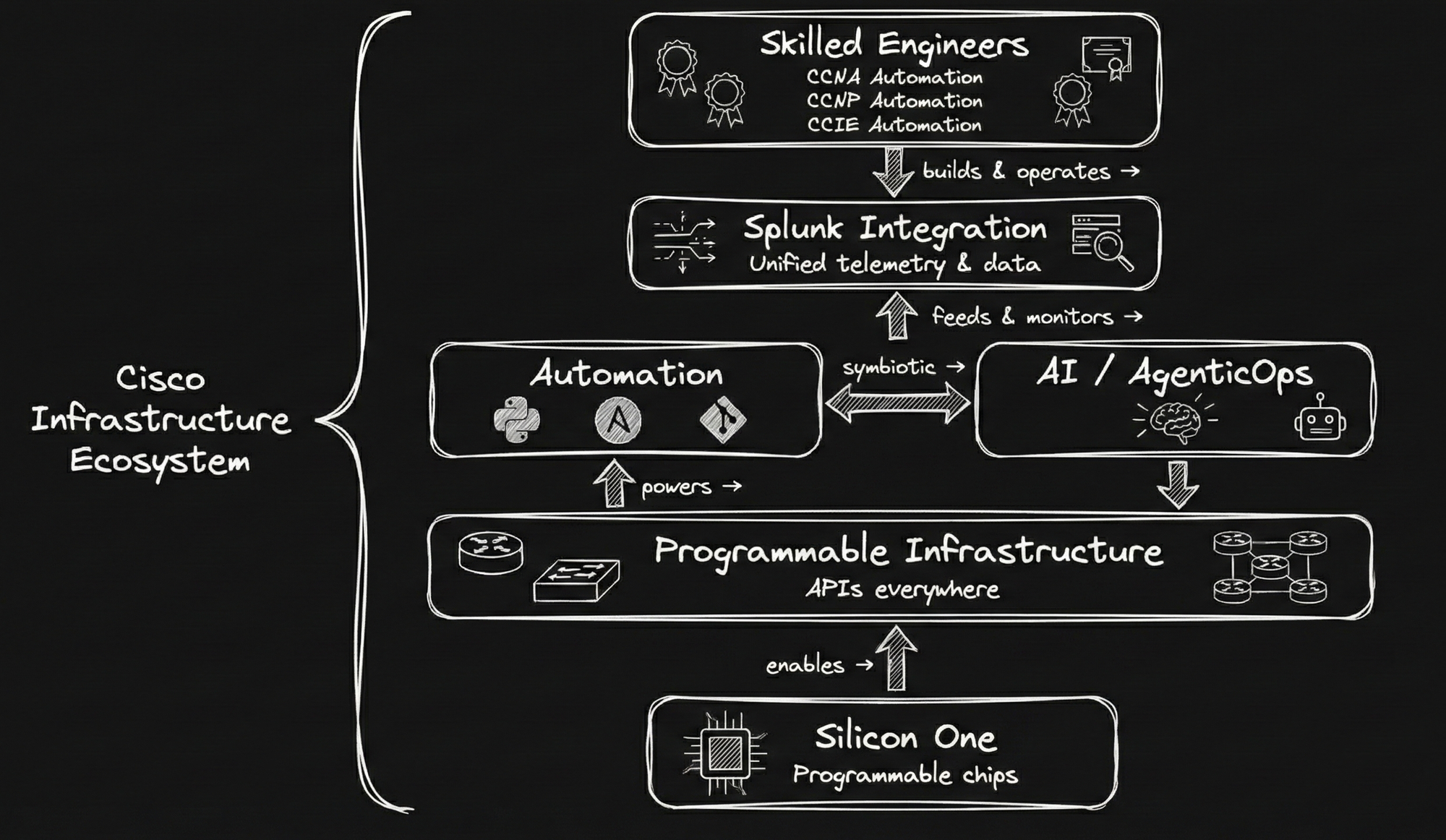
They're building networks that are programmable by default, with APIs baked into everything. Operations become data-driven through unified telemetry and Splunk integration. Intelligence gets embedded via AI agents that act on automation frameworks. And now, with CCNA/CCNP/CCIE Automation, the skills get standardized in a way that enterprises and hiring managers actually understand.
The Silicon One story makes Ethernet programmable for AI workloads. Hypershield distributes and automates security enforcement. The Splunk acquisition creates the data substrate AI needs to operate. And the DevNet-to-Automation rebrand ensures there's a pipeline of professionals who can actually deploy and optimize all of it.
It's an ecosystem play, and the certification rebrand was the final piece that makes the whole strategy coherent.
The DevNet Legacy
Here's the thing about DevNet: it did exactly what it was supposed to do, even if nobody knew what that was at the time.
When Susie Wee and her team launched DevNet in 2014, they were building something that didn't quite fit anywhere in Cisco's product portfolio. It wasn't pure networking. It wasn't pure software. It was this experimental space where network engineers could learn to code and developers could learn networking—at a time when most people thought those were separate careers.

Ten years later, we can see what DevNet actually accomplished. It proved that network automation wasn't a niche skill—it was the evolution of network engineering itself. What started as "network engineers learning to code" became "the network becoming programmable infrastructure." It created the certification track that validated automation as a professional discipline. It built the sandbox environments and learning labs that trained the first generation of network automation engineers. And it established the APIs and programmability frameworks that made Cisco's infrastructure actually automatable.
DevNet kick-started changes that helped Cisco compete in a market where networks needed to be software-defined, API-driven, and AI-ready. The rebrand to Automation doesn't erase that legacy—it validates it. What started as an experiment in a startup-minded corner of Cisco became the foundation for how the entire industry thinks about network operations.
Sometimes the most important innovations are the ones that make themselves obsolete by succeeding. DevNet built the bridge. Now that everyone's crossed over, we don't need a separate island anymore—automation is just how networks work.
The name changes, but the impact endures.
Key References:
DevNet Academy - CCIE Party Recognition Problem
Cisco Official Announcement - Learn with Cisco Evolution
PyNet Labs Analysis - Cisco DevNet is now Cisco Automation
Cisco Learning Blog - CCNP Automation Track Overview
CCIE Automation Official - DevNet Expert Transition
CBT Nuggets - Major Cisco Cert Changes
DevNet Dan - Cisco Live 2025 AI Canvas
Cisco Developer Blog - AI Agents Survey Results
PyNet Labs - CCNP Automation Salary Data
Cisco Automation Official - Exam Retirements
DevNet Journey Timeline - 10 Year Interactive Timeline
Matt Denapoli - DevNet Celebrates 10 Years