Skipping the Steak Dinner
Last week in Amsterdam, the producers asked me to talk about Cisco and AI on live television. I could have repeated the slogan. Instead, I skipped dinner to translate "Cisco is the critical infrastructure for the AI era" into something practitioners could actually use.
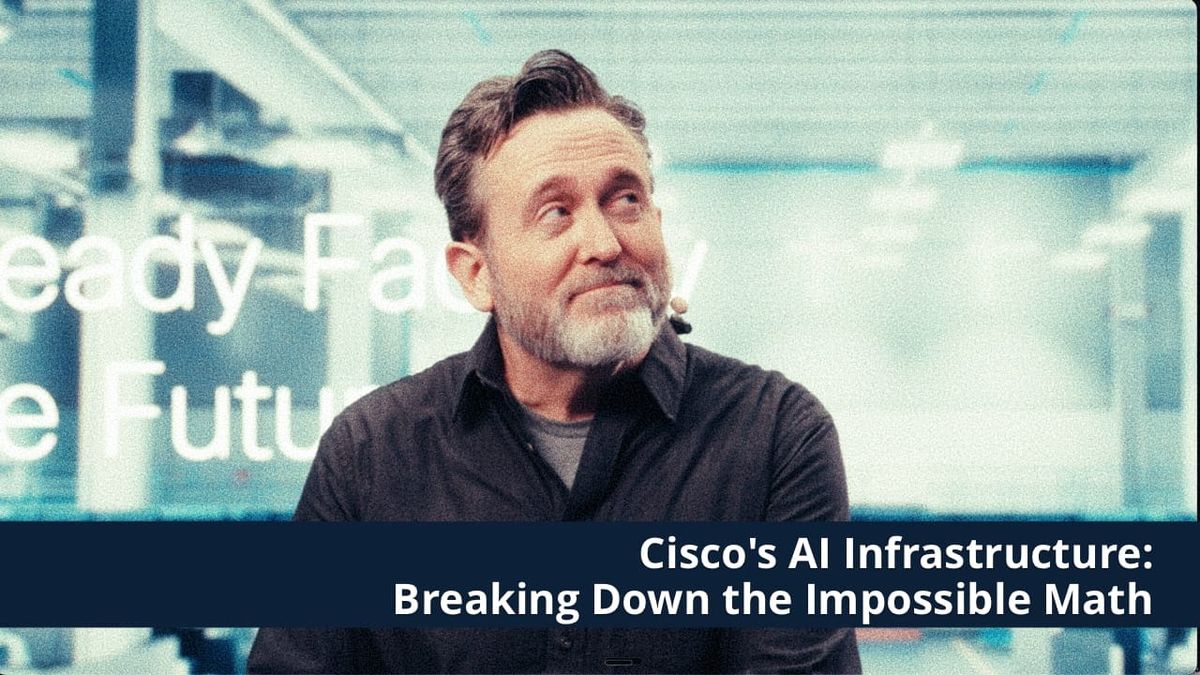
The most challenging speaking request isn't a scripted presentation—it's a blank slate.
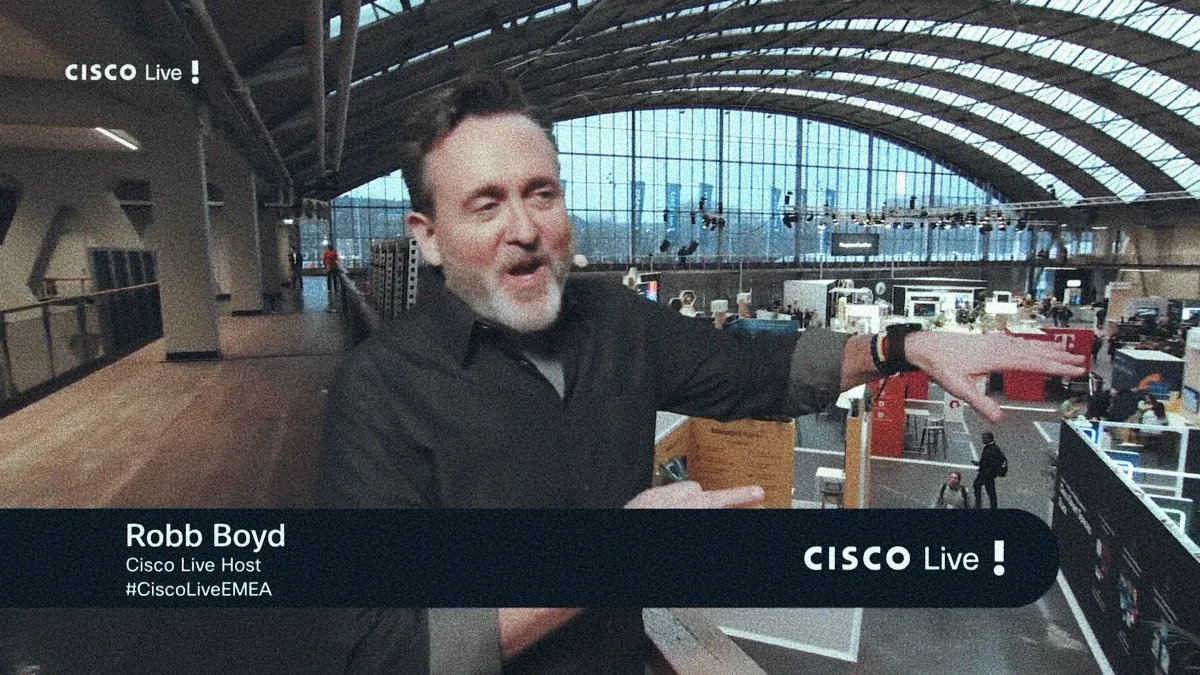
Last week in Amsterdam, while working as part of the Cisco TV host team, I got one of those blank slates. The prompt was as broad as it gets: "Can you talk to the camera for a bit about Cisco and AI?"
Our primary role as hosts is to provide a platform where executives, engineers, and customers can express their message. My fellow hosts are incredibly sharp, and we spent the week maintaining a live stream that moved at a breakneck pace, bouncing between remote camera teams and breakout stages. But every so often, the producers turn to me when they need something unscripted that digs into the "juicy details."
Making Sense of the Slogan
This year was the first year we were proactively given specific messaging guidelines as hosts. At the top was THE slogan: "Cisco is the critical infrastructure for the AI era." Beneath it sat the pillars: "Impossible Math" and "The Compounding Effect."
At these events, slogans can easily become wallpaper. But I knew that if the audience numbers were as massive as they seemed—rumors of a record-breaking 10M+ views—there were likely thousands of practitioners watching who might not instinctively connect those marketing dots to their own daily reality.
I didn't want to just repeat the pillars. I wanted to find the bridge between the slogan and the solution.
The Hotel Room Grind
I decided to use the opportunity to grow my own skills around articulating this value play. I wanted to give this message enough "meat" to show it was real. Without a teleprompter to lean on, I had to internalize the logic so I could deliver it naturally.
I skipped a steak dinner with the team at VQ Communications and stayed in my hotel room to cut through the noise. I wanted to translate "Impossible Math" into the reality of Silicon One and Job Completion Time. I wanted to turn "The Compounding Effect" into a story about how a Catalyst 9350 feeds Splunk high-fidelity telemetry that makes an entire business more resilient.
A Bit Deeper Than Usual
I'll admit, I took a little liberty with the length. The producers—being the professionals they are—knew exactly how long the segment was and made the timing work perfectly. But I wondered if anyone in the audience caught the extra depth.
The b-roll had to be chosen quickly, and while I'd always love more time to make the visuals even more precise, the goal was to speak to the incredible reality behind the messaging. I didn't want this to be a definitive lecture. I wanted it to be a spark—something to make a viewer curious enough to investigate these technologies further.
The approach was simple: prove it.
Don't just repeat "Cisco is the critical infrastructure for the AI era." Show the physics. Walk through the impossible math—AI workloads demanding 5-10x more power and throughput on infrastructure that wasn't built for it. Then connect three proof points: purpose-built infrastructure that actually scales (Silicon One, Nexus Hyperfabric, the new G300 chip), the compounding effect (Catalyst 9350 switches feeding Splunk with high-fidelity telemetry), and digital resilience through total visibility (ThousandEyes showing you outages in networks you don't own, Hypershield closing the loop).
The goal wasn't to be exhaustive. It was to give practitioners watching something concrete enough to take back to the office—not a slogan, but the underlying logic.
The Takeaway
Being a host is about keeping the stream alive. Being a technical host is about knowing when to step away from the surface-level talk and explain the "why." Sometimes, that means trading a social hour for a writing session to ensure that when the red light goes on, you're connecting the vision to the reality—and showing why it matters to someone configuring switches at 2am.