
Cisco’s AI Strategy: Cleaning the Garage First
Cisco didn't start with an AI feature. They started by fixing a historic mess.

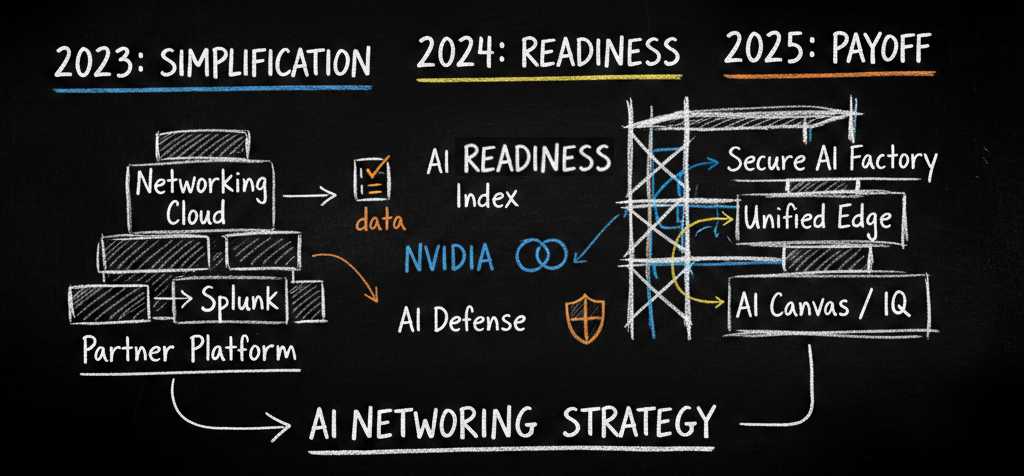
Or why you can’t build a modern network on top of a historic mess.
I didn’t set out to write a “Cisco is winning AI” post.
What I’ve been trying to do, especially over the last couple of years, is understand whether these AI announcements are a coherent roadmap or just a desperate sprint toward a buzzword.
Looking back now, what stands out to me is not any single product launch. It’s the sequence.
Cisco didn’t start with an AI feature. They started by simplifying the platform, consolidating data, and fixing operational friction. Only then did the AI story begin to make sense.
Seen through that lens, the last few years feel a lot more deliberate than they may have looked at the time.
Phase 1: 2023 - Simplification
Fix the platform before talking about AI
Cisco’s AI story didn’t really start with AI.
In 2023, most of the visible work was about simplification.
At Cisco Live 2023, the Networking Cloud vision showed up as an acknowledgment of a long-standing problem. Cisco’s portfolio was a collection of high-performing islands—powerful, but isolated by different operating models. Catalyst here. Meraki there. Different dashboards. Too much friction.
The Networking Cloud wasn’t pitched as an AI product. It was pitched as a way to manage the entire networking portfolio more consistently. In hindsight, that matters. AI does not work well on top of fragmented systems.
Later that year, at Partner Summit, the Splunk acquisition dominated the conversation. What stuck with me was how often leaders talked about data, not dashboards. This wasn’t about adding another monitoring tool. It was about building an observability layer that could actually feed intelligent operations later.
At the same time, Cisco was also cleaning up how partners engage with the company. The Partner Experience Platform and the move toward solution specializations signaled a shift away from selling boxes toward selling outcomes.
That may sound like channel housekeeping, but it matters. Over 90 percent of Cisco’s revenue flows through partners. If you want AI to land in the real world, the ecosystem has to be able to explain and deliver it.
Cisco spent 2023 reducing complexity and consolidating data. That is the digital equivalent of cleaning out the garage—unsexy work that has to happen before you can build anything new.
Phase 2: 2024 - Readiness
In 2024, the tone changed.
Instead of talking about AI as something layered onto existing products, Cisco started talking about AI readiness. The AI Readiness Index reframed the conversation in a useful way. Most organizations are not blocked by a lack of AI ideas. They are blocked by infrastructure that cannot support them.
That framing quietly pulled the conversation back to networking, security, and operations. Areas where Cisco already plays at scale.
At the same time, Cisco’s alignment with NVIDIA became more explicit. Not in a “we’re doing everything together” way, but in a very practical one. High-performance networking matters for AI. Silicon One matters. Validated designs matter.
What also stood out in 2024 was the beginning of a more serious AI defense story. Not just protecting networks that happen to carry AI traffic, but protecting the AI lifecycle itself. Training data. Models. Inference paths.
That was an important shift. AI wasn’t being treated as another application. It was being treated as something that needs to be secured differently.
Cisco wasn’t just saying “AI is coming.” They were saying “there is no AI without a network, and no AI without a secure network.” That is a claim very few companies have the hardware footprint to back up.
Phase 3: 2025 - Payoff
When the pieces finally come together
If 2023 was about fixing the platform, and 2024 was about reframing the problem, 2025 is the year where those decisions moved from the PowerPoint slides to the server racks.
The Cisco Secure AI Factory, developed with NVIDIA, became the centerpiece of this payoff. What makes it significant is that it isn’t just a reference architecture; it’s a pre-integrated stack where security isn’t an afterthought or an add-on; it’s a native property of the network fabric. By utilizing Hypershield and Hybrid Mesh Firewall, Cisco proved that the network itself could act as a distributed security fabric for AI workloads.
But the real shift in late 2025 was the pivot to the Edge.
At the November 2025 Partner Summit, Cisco introduced Unified Edge. This wasn't just another hardware refresh; it was a response to the reality that AI is moving out of the centralized data center. As organizations move toward Agentic AI—where autonomous AI agents perform tasks like real-time anomaly detection on a factory floor or inventory routing in a warehouse—latency and local security become the primary bottlenecks.
Jeetu Patel’s message was clear: AI Agents cannot wait for a round-trip to the cloud. By unifying compute and networking at the edge, Cisco is positioning itself as the only company that can provide the "on-ramp" and the "execution room" for these agents.
To manage this new complexity, Cisco introduced two critical AI-native interfaces:
- AI Canvas: Launched at Cisco Live 2025, this "generative UI" allows operators to visualize and troubleshoot the entire stack through natural language.
- Cisco IQ: Debuted in late 2025, this platform acts as the 'universal translator' for the data estate, giving partners and customers a unified, intelligent view of their entire Cisco and Splunk data estate.
By the end of 2025, the narrative has come full circle. Cisco is no longer just selling 'AI-labeled' hardware; they are delivering a full-stack, secure, AI-native platform that spans from the core data center to the furthest reaches of the network edge.
Stepping back
Looking at this as a sequence, not a set of announcements, the pattern becomes clearer.
Cisco did not rush to claim AI leadership. They fixed the platform first. They consolidated data. They aligned security and networking. Then they started building AI-native experiences on top.
That approach may not generate the loudest headlines. But it does generate something more durable.
A platform that can actually be deployed, operated, secured, and explained.
For me, that’s the most compelling part of Cisco’s AI networking story so far.