
Career Capital, Not Stock Options
Twenty-five years after the dot-com bubble burst, Cisco's stock finally exceeded its March 2000 high. My original shares never recovered. They expired underwater. Should I have stayed longer? The question doesn't apply—I couldn't have. What I learned and who I built with mattered more than equity.


I have a photo from 1999.
It was taken after I made President’s Club at MCI WorldCom. I’m in the middle, flanked by two executives at what was then one of the hottest telecom companies in the world.
The man on the right is Bernie Ebbers, WorldCom’s CEO. He was released from federal prison in December 2019 on compassionate grounds after serving time for orchestrating an $11 billion accounting fraud. He died two months later in his home in Brookhaven, Mississippi.
I left Cisco the same month Ebbers was released — December 2019. Almost exactly twenty years after leaving WorldCom.
That symmetry stuck with me.
How I Ended Up at Cisco
My path to Cisco wasn’t linear, but it was deliberate:
Westin Hotels → selling pagers for PageNet → MCI selling Polycom conferencing systems → back to Texas doing custom PictureTel video conferencing installations → a small satellite office in downtown Fort Worth, where I started at Cisco in November 2000.
Each move brought me closer to enterprise technology. Each paid better than the last. By the time I landed at Cisco, I was stunned by the compensation compared to hotel management or even the telecom world. This was real money — salary, benefits, and yes, stock options priced around $70.
Those options expired worthless years before I left.
The Headline That Triggered the Memory
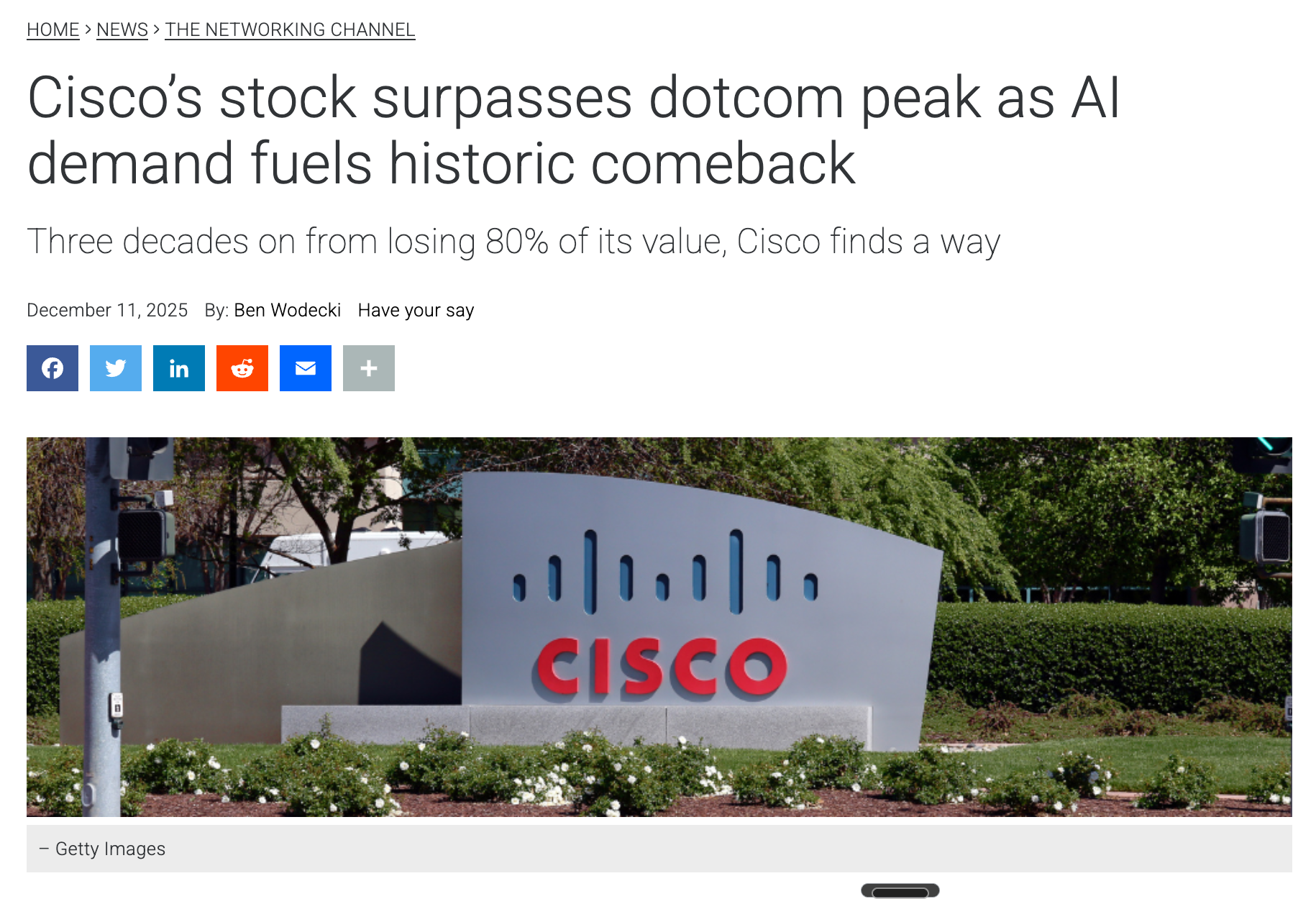
This week I saw a headline from SDxCentral:
“Cisco’s Stock Surpasses Dotcom Peak as AI Demand Fuels Historic Comeback.”
Twenty-five years after the dot-com bubble burst, Cisco’s stock finally exceeded its March 2000 high.
I left Cisco in December 2019, laid off after nearly two decades. My original shares never recovered. They expired underwater. Financially, I didn’t miss anything.
Should I have stayed longer? The question doesn’t really apply — I couldn’t have.
Could I have timed it differently? Not in any meaningful way.
That realization isn’t resignation. It’s clarity.
The Dot-Com Bubble’s Long Shadow
When I joined Cisco in November 2000, the company had briefly been the most valuable company in the world earlier that year. The stock was trading at extreme valuations based on projections that, in hindsight, assumed flawless execution on impossible timelines.
The internet was going to change everything. It just wasn’t going to do it all at once.
The crash wasn’t about Cisco failing. Cisco remained profitable, well-run, and dominant for decades. The issue was that the stock price had gotten so far ahead of reality that even excellent execution couldn’t close the gap.
When you’re valued as if you’ve already achieved twenty years of perfect growth, actually delivering that growth just brings you back to even.
That dynamic quietly shaped an entire generation of tech workers.
Cisco wasn’t unique. Microsoft, Intel, Oracle — many fundamentally strong companies spent years or decades growing into valuations set during the bubble. You could work for a great company, watch it succeed in the market, and still see your stock options expire worthless.
That was my experience.
The math is unforgiving. If a stock is overvalued by 300% and earnings grow at 10% annually, it can take fifteen years just to justify the original price — assuming the market doesn’t revise expectations downward in the meantime.
“Just hold” sounds wise until you remember that options expire. Vesting schedules end. Life moves forward.
The Myth of Perfect Timing
Nobody rings a bell at the top or the bottom — not even people inside the company.
The AI-driven resurgence lifting Cisco today wasn’t visible in 2019. The strategic pieces now paying off — Splunk, Silicon One, the evolution of the security platform — weren’t obvious enough to anchor any rational decision back then.
What staying would have meant was living through repeated resets:
the 2001–2002 crash, the 2008 financial crisis, years of analyst narratives calling Cisco a “value trap,” and long stretches of underperformance while other stocks surged.
We hear the stories of people who held Apple from 1997 or Amazon from 2001. We rarely hear from those who held Nortel, Webvan, or pets.com. And we almost never hear from people who held good companies and still ended up with worthless options.
Outcomes get credited to wisdom. Timing and luck rarely get acknowledged.
What Stock Options Really Are
Equity compensation is marketed as upside — alignment, ownership, participation in success. In practice, most options expire underwater. They’re a way to offer compensation that feels generous while transferring risk to employees.
There’s also a subtle psychological trap: people delay career decisions waiting for stock to recover or options to vest. Professional growth gets subordinated to a ticker symbol.
Stock compensation makes sense when it’s truly additive — when cash compensation already stands on its own, and equity can be treated as optional upside. For many employees at mature companies, that isn’t the reality.
That’s not bitterness. It’s context.
What I Actually Got From Those 19 Years
Here’s the part that matters most to me now:
I never experienced false wealth.
I didn’t ride the late-90s surge only to watch it evaporate. I joined after the reset, with realistic expectations about what the job paid and what it didn’t promise.
The people who joined Cisco in 1997 or 1998 often endured psychological whiplash — paper wealth, sudden loss, paralysis. Some left. Some stayed too long. Some made decisions anchored to stock price instead of trajectory.
I was spared that.
My Cisco years were about building.
I built TechWiseTV into a platform that reached over 65 countries and earned more than 25 industry awards and Emmy nominations. More importantly, I worked with some of the smartest people in the industry — engineers shaping the future of networking, executives making billion-dollar decisions, and practitioners who understood both the technology and the business forces behind it.
I built relationships that still compound. Cisco remains part of my professional life today, from a different angle — as an independent analyst and content creator.
When I left, the stock options stayed behind. The career capital came with me.
The Real Lesson
You can’t time the market — even from the inside.
What you learn, who you learn from, and what you build matters more than equity that may never materialize.
That SDxCentral headline sent me back to that 1999 photo — standing between two WorldCom executives at the height of telecom optimism. Bernie Ebbers died in disgrace the same month I left Cisco, exactly twenty years later.
Stock prices tell dramatic stories. Careers tell quieter ones.
Mine worked.
And I’d make the same trade again.