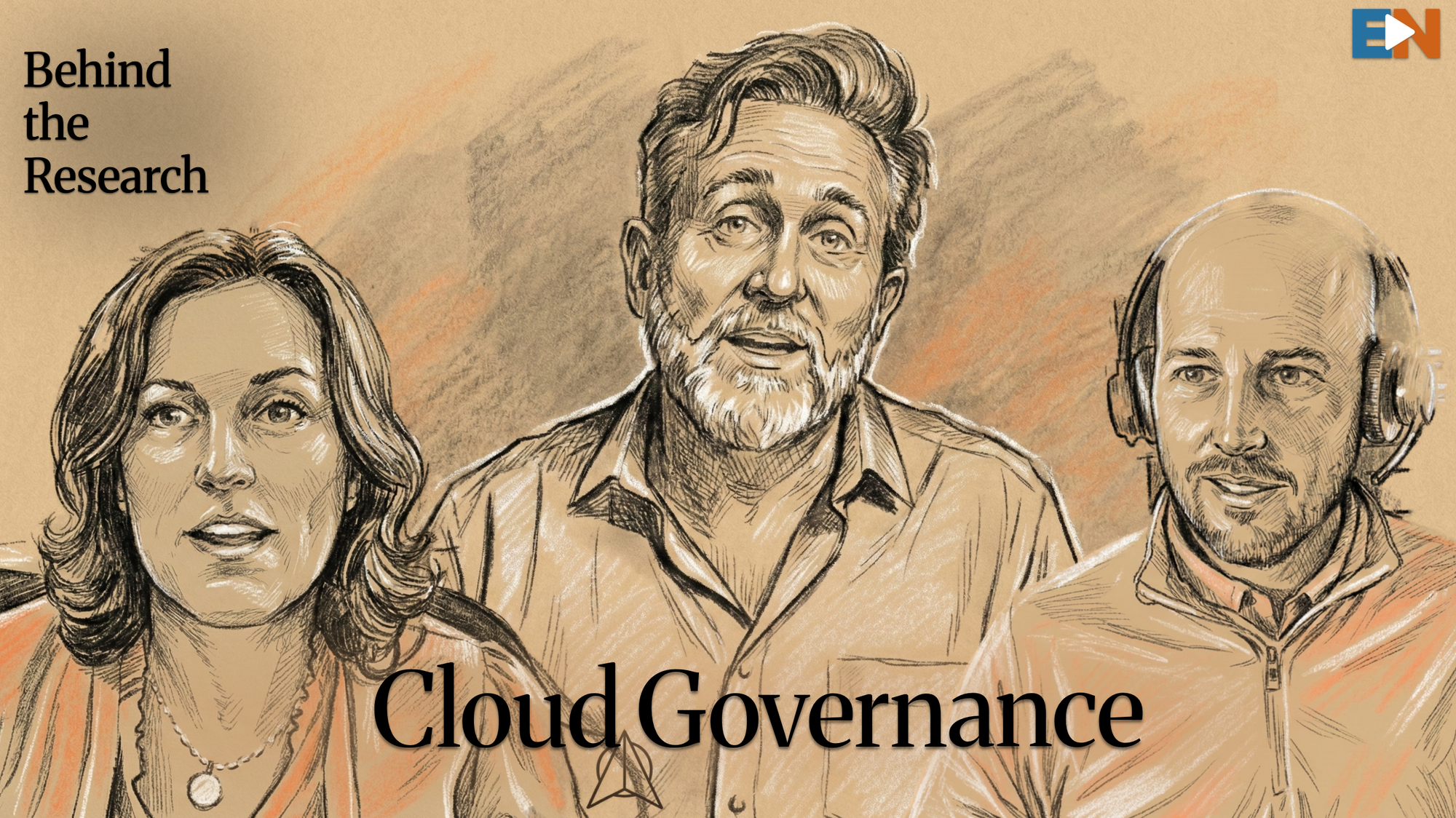
Behind the Research: The Cloud Governance Hamster Wheel
Companies think they're more mature than they are. They have governance, committees, FinOps. Dig one level deeper: no tagging strategy, no chargeback, no way to trace spend. The problem isn't tools or data—it's organizational structure with actual authority.

Part of the Strategic IT Value Creation series
Jenny Halidik and Josh Bushman explain why your optimization efforts keep failing—and it's not a tool problem.
Josh was five minutes late to our call.
"Apologies," he said. "Jack in London is pinging me about a meeting tomorrow."
This is pretty much how these conversations go. Someone's dealing with something urgent in another timezone. Someone's firefighting a spend spike from three months ago. Nobody calls when everything's running smoothly.
The Weird Org Chart Problem
About twenty minutes in, I asked them to explain their roles to each other.
Josh laughed. "I've got a really weird mix on my team. TSAs, BDMs, operational people, partner managers working with software vendors. It's just... a weird mixture."
Jenny agreed: "I have this weird role too. Business development, but focused on FinOps, but also pinch-hitting when needed."
Here's what I loved about that moment: these roles exist because the problem is messy. You can't solve cloud governance with a clean org chart. The teams are weird because the problem evolved faster than anyone expected.
"We started off separate," Jenny said. "Thought it would just be cost optimization from a services side, then we started seeing the bigger picture of what clients were really trying to solve for."

The Hamster Wheel
Jenny kept coming back to this image: "It's very difficult to continue optimizing if you're continually bringing new workloads on. Cloud is super dynamic. Without structure, you're on that hamster wheel."
Working hard. Implementing recommendations. Right-sizing instances. Cleaning up unused resources.
Three months later, costs creep right back up.
"Companies may have a governance policy they start with. Then through quick growth or acquisitions, it just breaks down."
You're not failing to optimize. You're optimizing without organizational structure to make it stick.
The Three-Month Problem
Josh said something that stuck with me: "I can't tell you how many times we get brought into a conversation about a commit with a cloud provider three months before they're ready to close it. At that point, it's way too late."
Three months before a multi-million dollar commitment.
"When you're going to make a commit to a hyperscaler, you really want at least nine months to a year. You want good governance in place and buy-in from multiple business units."
But here's what actually happens: "We see it everywhere. A CFO signs a large commit because they're getting investment from Google or AWS or Microsoft. They say yes to this huge commit before checking with the CTO."
Someone signs a $3 million commitment based on projected growth and vendor incentives. Six months later, you're locked in, costs are spiraling, and nobody consulted the people who understand the workloads.
Two Companies, Same Problem, Different Outcomes
Josh told me about a large retail client with governance and software purchasing committees in place. When people tried buying software on credit cards—creating three or four redundant purchases of the same tool across business units—the committees shut it down.
Contrast that with a major utility company. They have a FinOps team but limited governance. Same software sprawl. Same rogue purchasing.
A large organization with a FinOps team—probably talented people working hard—dealing with the same sprawl as companies without any governance at all.
The difference? Organizational structure with actual authority.
The Buy-In Problem
"It's great to have a FinOps practice," Josh said, "but if you don't have buy-in across the board—if the FinOps department says your cloud spend increased and makes recommendations, but nothing happens—what's the point?"
Jenny: "That's where companies struggle with the people and process aspect. Getting that muscle memory where stakeholders start thinking with a financial hat on."
You can have tools. You can have data. You can have smart people making good recommendations.
But if a developer doesn't want to be slowed down, and there's no organizational authority saying "we're implementing this," nothing changes.
The Maturity Gap
This came up multiple times: companies think they're more mature than they are.
"A lot of companies think they're more mature than they really are," Jenny said. "When you get into the table stakes of what they should be doing, it's 'well, yeah, we could clean this up.'"
Josh: "We see it all the time. A company says they have a committee for software or cloud spend. Then we ask: are you doing chargeback or showback? They go, 'No. How do we do that?'"
They have governance. They have committees. They have FinOps.
Dig one level deeper: no tagging strategy. No chargeback. No way to trace spend back to business units.
The Amazon Problem
We were talking about tagging and I brought up my personal chaos—trying to figure out what I'm spending on Amazon because everything just shows up as "Amazon."
Josh laughed: "Great analogy. You could throw in: is it the kids? The wife? You?"
Then: "I'm at 22 with my oldest, 18 with the youngest. Still paying those bills."
I couldn't help myself: "At what point can they still hit your Amazon card? Should you still pay their cell phone?"
"I don't have the answer yet."
It's the same problem enterprises have, just exponentially larger. Multiple business units. Multiple buyers. Everything rolling up to bills that don't tell you who bought what or why.
What the Video Covers
Jenny and Josh walk through four strategic practices:
- Establish a Cloud Center of Excellence as your FinOps foundation
- Optimize before you commit (not after you're locked in)
- Implement continuous optimization (not episodic firefighting)
- Strategic vendor and tool consolidation
But the real message is simpler: you can't tool your way out of this. You need organizational structure that brings the right people together with actual authority to govern spending.
Full research paper: Strategic IT Value Creation (available at wwt.com)
What's Actually Missing
It's not tools. Cloud providers give us plenty.
It's not data. We're drowning in it.
What's missing is organizational structure that turns inputs into coordinated action with actual authority.
Jenny called it a Cloud Center of Excellence—"the governing body that mandates governance policies and makes sure they're implemented."
Josh was blunt: "You can't have one FinOps department trying to get buy-in from everybody. You have to have that before you start. Otherwise there's no way to control it."
Why This Matters Now
After our recording session, Jenny mentioned something in passing: "We started off thinking it was just cost optimization from a services side, and then started to see the bigger picture of what clients were really trying to solve for."
That evolution—from "we need to cut costs" to "we need organizational capability"—is where most companies are stuck right now.
They're optimizing. They're using tools. They're working hard.
But they're on a hamster wheel because nobody has authority to make the organizational changes that would make optimization sustainable instead of episodic.
The question isn't whether you should optimize your cloud spend. The question is whether you're building the organizational foundation that makes optimization something other than constant firefighting.
This is part of the work I do with World Wide Technology's research team. More at explainerds.net.