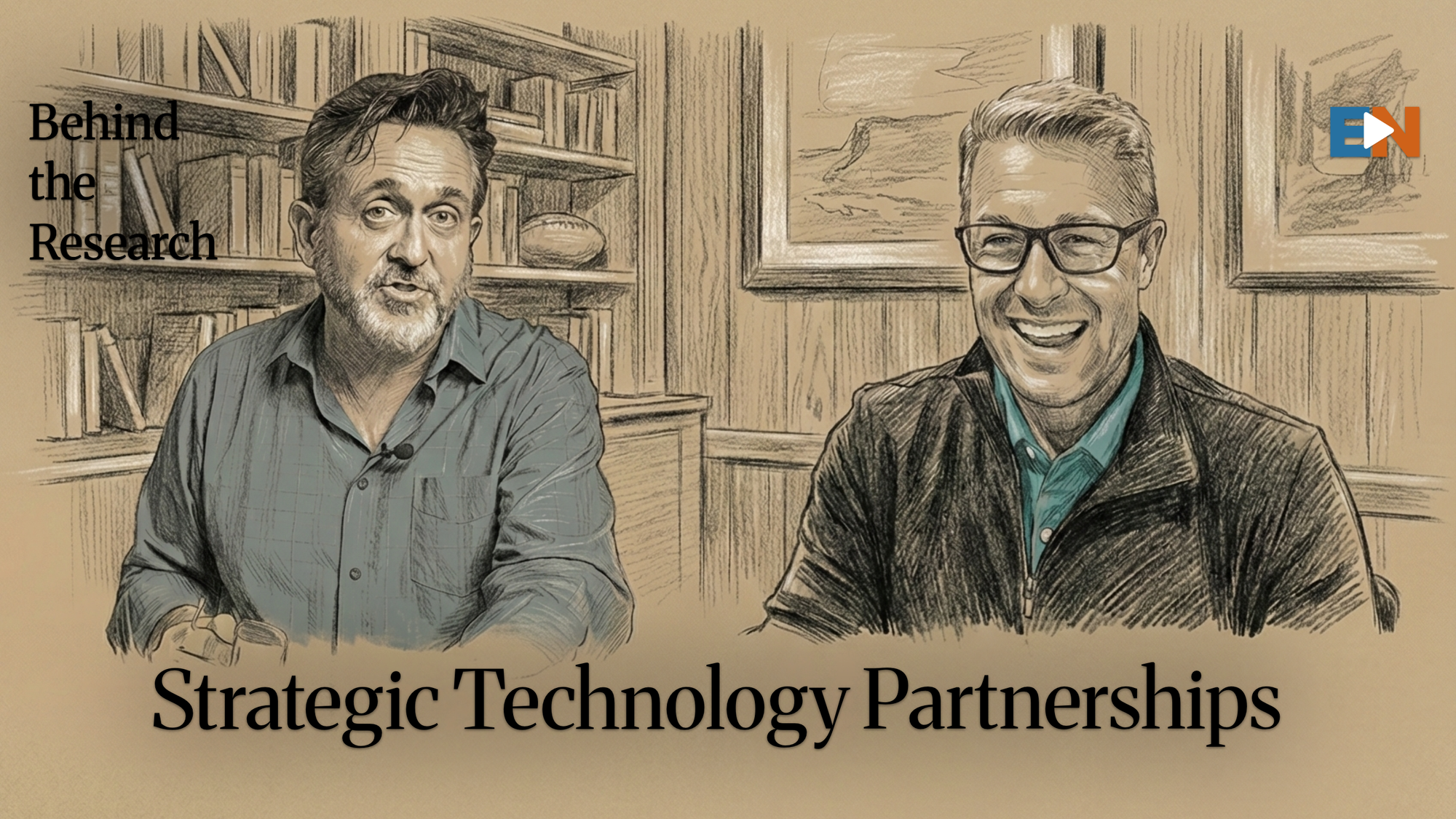
Behind the Research: Strategic Technology Partnerships
Your "15% discount" might be burning millions. Servers sit in boxes for 90 days. Depreciation ticks. Maintenance runs. Warranty expires. That discount? Gone before the first server boots. This is what happens when procurement is transactional, not strategic.

Part of the Strategic IT Value Creation series
Matt Long walks through why the 15% discount your procurement team is celebrating might actually be costing you millions.
Matt Long walks through why the 15% discount your procurement team is celebrating might actually be costing you millions.
Matt Long kept saying "I know this isn't a commercial."
We were about 20 minutes into our first conversation about procurement and technology partnerships, and he'd already said it three times. Each time after making a point that was, admittedly, pretty compelling about how World Wide Technology approaches these problems.
"I'm not trying to be salesy," he said. Then immediately launched into another example that was... well, it was salesy. But it was also true.
That tension—between "here's what we do" and "here's what actually matters"—turned out to be the most interesting part of preparing this conversation.
The Question Nobody Wants to Ask
About 30 minutes into our second prep call, Matt got uncomfortable.
I'd written something in the draft about "eliminating manual procurement processes" as a best practice. Matt stopped me: "That one makes me nervous."
Why? Because WWT still has manual processes. Lots of them. Bills of materials get built by hand. Quotes go back and forth. Even with their most electronically integrated customers, there are people doing work that isn't automated.
"We don't have this super streamlined, elegant, automated purchasing vehicle," Matt admitted. "We still have a lot of room for growth."
Here's what I love about that moment: Matt could have just nodded along with the aspirational language. Instead, he called it out. Because when you're asking customers to think differently about procurement, you can't be full of it about your own processes.
The Meeting Where Nobody Showed Up
Matt told me about sitting in a conference room with senior IT stakeholders at a large enterprise. The sourcing team was supposed to be there. They weren't.
One of the IT folks finally said it out loud: "I need my colleagues in sourcing to be on the same page with me. We need to be operating as a cohesive team to move forward with what we need to get done."
Matt contrasted that with another client where they had sourcing, IT, and the line of business in the room together. "It's just a very different dynamic," he said. "When you can get everyone aligned, transformation becomes achievable."
I asked him: "What happens when they don't align?"
"I'd argue it's almost impossible to achieve those end objectives without that type of cohesion."
Not difficult. Impossible.
When Your Discount Disappears
This is the part that stuck with me.
Your procurement team negotiates a massive discount—let's say 15%. Everybody's celebrating. Purchase orders go out. Equipment ships.
Then it sits in boxes for 90 days because facilities aren't ready and implementation is behind schedule.
Depreciation starts. Maintenance contracts tick away. Warranties count down. All the labor that went into research and proof of concept? Nobody ever counted it as a cost.
"That big discount you negotiated on the front end is completely gone," Matt said. "Because you didn't have an implementation plan and you weren't ready to absorb the investments you were making."
He wasn't making this up. When you're dealing with customers spending hundreds of millions to billions annually on technology, "little movements on those types of things have big impacts financially."
The Amazon Problem, But Make It Enterprise
I tried to relate this to something personal: my complete inability to track what I'm actually spending on Amazon.
Everything goes on a credit card. We get points. We pay it off monthly. But breaking down individual purchases? Nightmare. And subscriptions? Don't get me started on the number of things I'm paying for monthly that I've completely forgotten about.
Matt had never thought about it that way, but yeah—that's exactly the enterprise problem, just exponentially larger.
"Where you have a single line item and you don't necessarily know what's in there, that's where you can have duplicative spend," he said. "No different in the enterprise space where you buy an enterprise agreement over here, there's another enterprise agreement over there—where's the Venn diagram overlap?"
What Matt Didn't Want to Say
There were things Matt told me in our prep calls that he wouldn't say on camera.
Things about OEMs. Things about how certain partners operate. Things about what happens when you treat technology purchases as purely transactional.
"There are things I would say to customers that I would never say in front of an OEM rep," he told me.
That's actually part of the value proposition, though he'd never phrase it that way publicly. Being able to have conversations that are in the customer's interest, not the vendor's interest—that matters.
But it also makes this kind of content tricky. You want to be useful. You want to be honest. But you also can't burn bridges in an industry where everybody knows everybody.
So we danced around it. Talked about principles instead of players. Spoke in generalities that people who work in this space would immediately recognize as specific.
The Five Practices Nobody's Implementing
The video covers five strategic practices for transforming procurement:
- Strategic sourcing and category management
- Lifecycle cost analysis (not TCO—Matt hates that term)
- Vendor risk management as a continuous process
- Standardization and rationalization
- Agile procurement with contract flexibility
But here's what I learned preparing this: almost nobody is doing all five. Most organizations are maybe doing two, and doing them inconsistently.
The gap isn't knowledge. These aren't secret practices. The gap is organizational alignment, measurement systems that reinforce the wrong behavior, and the sheer momentum of "this is how we've always done it."
Matt kept coming back to silos. Not because silos are built maliciously—they're built out of speed. Procurement gets measured on cost savings. IT gets measured on uptime. Business units get measured on quarterly results.
Nobody's optimizing for the whole system.
What Actually Matters
After two prep calls and the recording session, here's what I think matters most from this conversation:
Where you start the clock matters. If you're only measuring costs from point of purchase forward, you're missing millions in labor, research, and opportunity cost that happened before that purchase order got signed.
Organizational alignment isn't optional. You can have the smartest procurement team and the most innovative IT department, but if they're not in the room together making decisions, you're leaving value on the table.
The 15% discount isn't the win you think it is. Not if equipment sits in boxes. Not if warranties expire before implementation. Not if you're paying maintenance on things that aren't running yet.
Your partners know things you don't. This is where Matt got careful with his words. But the reality is: if you're treating every interaction as transactional, you're missing insights that could save you millions.
Resources:
- Full research paper: Strategic IT Value Creation (available at wwt.com)
- Video conversation: See above for the complete discussion with Matt
This is part of the work I do with World Wide Technology's research team. More at explainerds.net.