Behind the Research: Software Spend Management
80% of your budget goes to 20% of your vendors—the ones you manage obsessively. Then there's the long tail: hundreds of smaller subscriptions nobody's tracking. Sound familiar? Your procurement team isn't failing. They're drowning in the obvious while the less obvious compounds.

Part of the Strategic IT Value Creation series
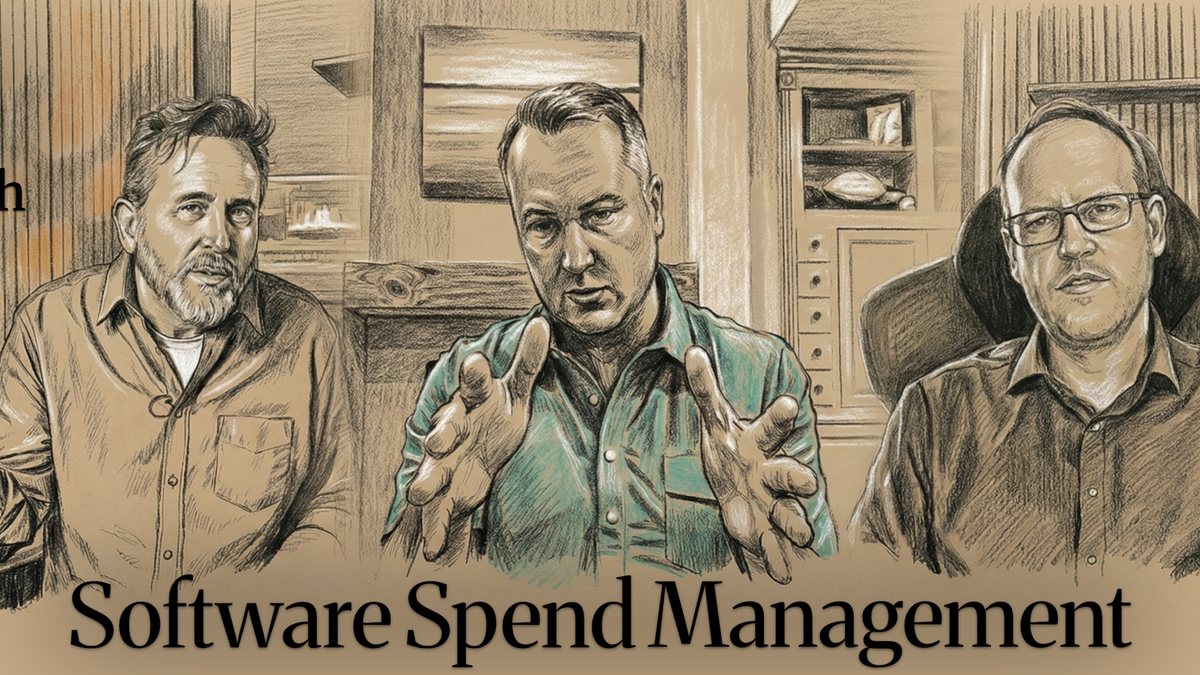
Andrew Tookey and Sean McDonald walk through the four practices that separate organizations with optimized software portfolios from those just reacting to renewals.
I had to ask Andrew three times what his job title was.

Not because he's unclear about his work—Andrew Tookey knows exactly what he does. It's because every time he described it, I realized the problem he solves doesn't fit into neat categories. "Software Asset Management and Tail Spend Advisor," he finally offered. Then added: "Well, when I'm explaining it to customers..."
That hesitation tells you everything about why this is hard.
My Own Spreadsheet Confessional
About 20 minutes into our first call, I made a confession that seemed to land harder than I expected.
"I have subscriptions where I don't even remember how I'm paying for them. Some go through Amazon Prime, some through Hulu, some direct. By the time I figure out what I'm actually spending on music services alone..."

Sean McDonald jumped in: "That's exactly what we see with procurement teams. You look at your mortgage, your car payment—those get scrutinized. But those smaller subscriptions? You're not checking your credit card receipt every month to see if you're still paying for that 90-day trial you forgot about."
I wasn't trying to make a point about enterprise software. I was genuinely embarrassed about my own chaos.
Turns out that embarrassment is the point.
The 80/20 Nobody's Managing
Here's the pattern Andrew and Sean kept coming back to: 80% of your budget goes to 20% of your vendors. Microsoft, Cisco, Palo Alto. The platforms you'd be in serious trouble without. Everyone manages those obsessively.
Then there's this long tail. Hundreds, sometimes thousands of smaller vendors. Andrew used to call it "weird spend," then caught himself: "We moved away from that years ago because if I have a software product, I don't like you calling it weird."
Fair point. But here's the thing—that tail represents 80% of your vendors. And most procurement teams don't have time to look at any of them closely.
They're too busy negotiating the Microsoft Enterprise Agreement.
The Cisco Smartsheet Rebellion
The story that made this personal: Cisco tried to eliminate Smartsheet because they already had Excel. Perfectly logical—why pay for two tools that do the same thing?
Employees petitioned the CEO to keep it.
This isn't about spreadsheets. It's about the fact that when you call someone up and ask if they really need that tool they signed up for, they're going to say yes. Always.
"If you ring up Andrew and say, 'Andrew, you've got this one piece of software,' I'm always gonna say I need it," Andrew admitted. "I'm protective. It's mine."
Or at least, it makes me remember I probably should be using it more.
The Half-Million Dollar RAM Upgrade
One more story, because this is the kind of thing that only surfaces when someone's actually paying attention:
A customer asked WWT to price out additional SQL licenses for new servers—about $500,000 worth. Standard request. Easy transaction.
Except WWT's solutions architect had previously built this customer's SQL farm. His reaction: "Hang on, we just built that. It's new, it's designed to scale. Why do they need more capacity already?"
They asked to see the logs. Turned out to be a memory issue, not capacity.
Recommendation: Buy new RAM. Cost: way less than $500,000.
The customer was about to spend half a million dollars because that's what the problem looked like from where they were standing. Sometimes you need someone outside your context to see what you can't.
What the Video Covers
Andrew and Sean walk through four specific practices for getting control of this: establishing visibility, optimizing based on actual usage, aligning licensing with business cycles, and consolidating vendor relationships strategically.
All practical. All things you can act on.
But I wanted to start here—with the messy reality of why this is hard. Because if you're feeling like your software spending is out of control and you're not quite sure how to get your arms around it, that's not a failure of process.
It's just really difficult to see patterns when you're standing inside them.
Your procurement team isn't asleep at the wheel. They're drowning in the obvious stuff, which means the less obvious stuff keeps compounding.
The question isn't whether you need to deal with this. The question is whether you can see it clearly enough to know where to start.
Sometimes the first step is just admitting you need help seeing what's right in front of you.
Resources:
- Full research paper: Strategic IT Value Creation (available at wwt.com)
- Video conversation: See above for the complete discussion with Andrew and Sean
This is part of the work I do with World Wide Technology's research team. More at explainerds.net.